
How Fast Do Bullets Travel? Bullet Speeds by Caliber, Explained
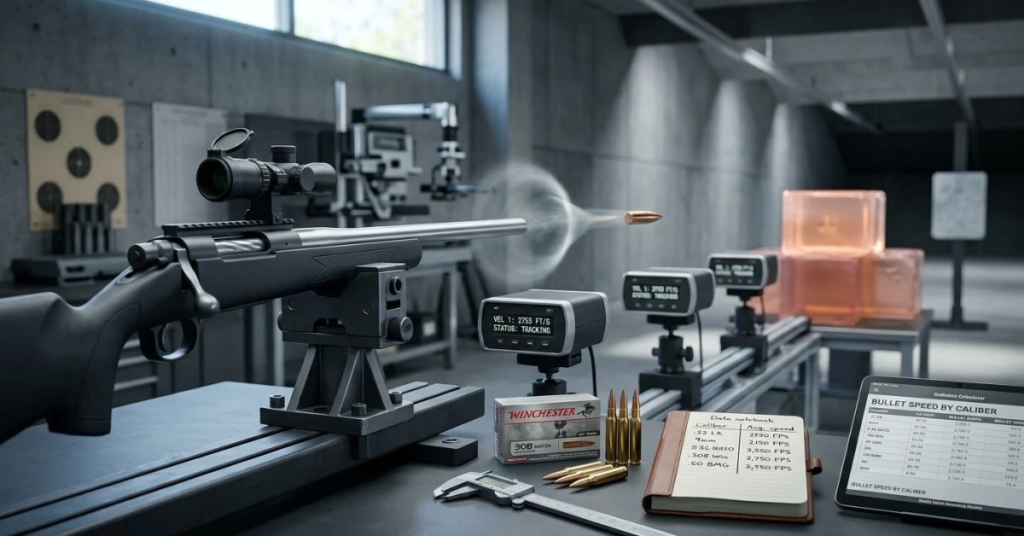
Quick answer: Most How Fast Do bullets Travel leave the muzzle at about 800 to 4,000 feet per second (fps), or roughly 245 to 1,220 meters per second (550 to 2,700 mph). Handgun bullets typically travel 800 to 1,500 fps. Rifle bullets typically travel 2,000 to 3,300 fps. Many rifle bullets fly at more than twice the speed of sound.
Key Takeaways
- Speed of sound: About 1,125 fps (343 m/s, 767 mph) at sea level and 68°F (20°C).
- Handguns: Typically 800 to 1,500 fps, with many loads near or just above the speed of sound.
- Rifles: Typically 2,000 to 3,300 fps, and the fastest commercial cartridges reach about 4,000 fps.
- Bullets slow down. Air drag steadily reduces speed after the bullet leaves the barrel.
- Barrel length, bullet weight, powder, and temperature all change velocity.
- Speed is not the same as energy. A heavier, slower bullet can carry more energy than a lighter, faster one.
Bullet Speed Chart by Caliber
These figures show typical factory loads at the muzzle. Exact speeds vary by manufacturer, bullet weight, and barrel length.
| Cartridge | Muzzle Velocity (fps) | Approx. m/s | Approx. mph |
|---|---|---|---|
| .45 ACP | 830–950 | 253–290 | 565–650 |
| .22 LR (standard) | 1,050–1,250 | 320–380 | 715–850 |
| 9mm Luger | 1,100–1,250 | 335–380 | 750–850 |
| .357 Magnum | 1,200–1,500 | 366–457 | 820–1,020 |
| 12-gauge slug | 1,200–1,800 | 366–549 | 820–1,230 |
| 7.62×39mm | 2,300–2,400 | 700–730 | 1,570–1,640 |
| .308 Winchester | 2,600–2,850 | 790–870 | 1,770–1,940 |
| .30-06 Springfield | 2,700–2,900 | 823–884 | 1,840–1,980 |
| .50 BMG | 2,800–3,000 | 853–914 | 1,910–2,050 |
| .223 Rem / 5.56 NATO | 2,900–3,300 | 884–1,006 | 1,980–2,250 |
| .300 Winchester Magnum | 2,900–3,200 | 884–975 | 1,980–2,180 |
| .220 Swift | about 4,000 | about 1,220 | about 2,730 |
For quick conversions, 1,000 fps equals about 305 m/s or 682 mph.
How Fast Is That Compared With the Speed of Sound?
Sound travels at about 1,125 fps under standard conditions. Any projectile above that speed is supersonic, and any projectile below it is subsonic.
- Supersonic: Most rifle bullets and many 9mm and .357 Magnum loads.
- Subsonic: Standard .45 ACP loads and specialized subsonic ammunition.
This explains a classic effect. A supersonic bullet can reach a distant target before the sound of the shot does. It also creates a sharp “crack” as it passes, which differs from the muzzle blast.
What Determines How Fast a Bullet Travels?
Several factors work together:
- Powder charge and type. More energy from burning propellant pushes the bullet faster.
- Bullet weight. Lighter bullets usually leave faster than heavier bullets in the same cartridge.
- Barrel length. A longer barrel gives the expanding gas more time to push the bullet. Rifles often gain roughly 25 to 50 fps per added inch, up to a point, but the effect varies by cartridge.
- Cartridge size and case capacity. Larger cases hold more powder.
- Temperature. Some powders burn faster in heat and slower in cold.
- Altitude and air density. These affect drag after the bullet exits.
Handgun barrels are short, which limits their velocity compared with rifles.
How Fast Do Bullets Slow Down?
Every bullet decelerates once it leaves the barrel. Air resistance (drag) pulls on the bullet, and gravity pulls it downward.
A bullet’s ballistic coefficient (BC) describes how well it resists drag. A higher BC means the bullet holds its speed better. Long, pointed, streamlined bullets carry the highest BCs.
Some practical examples:
- Many rifle bullets lose roughly 8 to 10 percent of their speed in the first 100 yards, depending on shape and weight.
- Handgun bullets slow quickly and typically drop below the speed of sound at modest distances.
- Light, fast bullets shed speed faster than heavy, streamlined ones.
Speed vs. Energy: Why Faster Does Not Always Mean More Power
Kinetic energy depends on both mass and velocity. In ft-lbs, the formula is:
Energy = bullet weight (grains) × velocity² ÷ 450,240
Here are three examples:
| Load | Weight | Velocity | Approx. Energy |
|---|---|---|---|
| 9mm | 124 gr | 1,150 fps | about 364 ft-lbs |
| .223 Rem | 55 gr | 3,200 fps | about 1,251 ft-lbs |
| .308 Win | 168 gr | 2,650 fps | about 2,620 ft-lbs |
Velocity counts twice in the formula (it is squared), so speed matters a lot. But the .308 beats the .223 because it adds significantly more mass.
How Fast Is a Bullet Compared With Other Things?
| Object | Approx. Speed |
|---|---|
| Fastball (professional pitch) | about 95–100 mph (about 140–147 fps) |
| Compound-bow arrow | about 250–350 fps |
| Speed of sound | about 1,125 fps (767 mph) |
| 9mm bullet | about 1,150 fps (790 mph) |
| Concorde cruising speed | about Mach 2 (about 1,350 mph) |
| .223 bullet | about 3,200 fps (2,180 mph) |
A rifle bullet moves faster than an airliner’s top speed and faster than the sound of most rifle shots reaches your ears.
How Long Does a Bullet Take to Reach a Target?
At 3,000 fps, a bullet covers 100 yards (300 feet) in about 0.1 seconds. Flight time grows with distance because the bullet slows down along the way.
Human reaction time to a visual stimulus is about 0.2 seconds. That means no person can see a bullet coming and dodge it. Nor can you outrun one.
How Do Shooters Measure Bullet Speed?
Shooters use a chronograph, a device that records how fast a bullet passes through two sensors. Hunters and handloaders use chronographs to confirm their load’s real velocity, which often differs from the box’s printed figure.
Manufacturers publish velocity data for each load, and independent testing often shows variation from batch to batch. Treat the numbers on the box as a guide, not a guarantee.
What Hunters and Sport Shooters Should Know
- Match the load to the game. Energy and bullet construction matter more than raw speed.
- Check the bullet’s expansion range. Some hunting bullets need a minimum impact velocity to expand properly, and distance reduces speed.
- Chronograph your own rifle. Your barrel length and ammunition will not match the box’s test barrel exactly.
- Know your backstop. A bullet that misses can travel far beyond your target, even after it slows down.
Tips for Writers, Gamers, and Media Creators
- Skip the slow-motion tracer unless the scene demands it. Real bullets move too quickly to see in ordinary conditions.
- Remember the crack and delay. At distance, a listener hears the supersonic crack before the muzzle blast.
- Model bullet drop and travel time in games and simulations when realism matters.
- Avoid the “dodge a bullet” myth. Characters cannot react to a bullet in flight.
- Match the weapon to the speed. Handguns, rifles, and shotguns behave very differently in range, speed, and recoil.
Common Myths About Bullet Speed
- Myth: Bullets travel at the speed of sound. Fact: Most rifle bullets travel much faster, and some handgun loads travel slower.
- Myth: A bullet fired upward stays dangerous forever. Fact: Gravity and drag slow it as it falls, but a falling bullet can still seriously injure someone. Never fire a gun into the air.
- Myth: Faster always means deadlier. Fact: Bullet weight, construction, and shot placement all matter.
- Myth: You can see a bullet in flight. Fact: Tracer rounds are the main exception, and they glow because they carry a burning compound.
Frequently Asked Questions
How fast does a bullet travel in mph?
Most bullets travel between about 550 and 2,700 mph at the muzzle. A 9mm travels about 750 to 850 mph, and a .223 travels about 2,000 to 2,250 mph.
How fast does a bullet travel in fps and m/s?
Typical speeds run from about 800 to 4,000 fps (about 245 to 1,220 m/s).
What is the fastest bullet speed?
Among common commercial hunting cartridges, the .220 Swift and a few similar small-bore rounds reach about 4,000 fps. Experimental and laboratory projectiles can go faster.
How fast does a 9mm bullet travel?
Standard 9mm loads travel about 1,100 to 1,250 fps (about 335 to 380 m/s). Some heavier loads run slower.
How fast does a rifle bullet travel?
Most rifle bullets leave the muzzle at about 2,300 to 3,300 fps (about 700 to 1,000 m/s).
Do bullets travel faster than the speed of sound?
Most rifle bullets do. Many handgun bullets also do, though some, such as standard .45 ACP loads, do not.
Do bullets slow down in flight?
Yes. Drag steadily reduces their speed, and a higher ballistic coefficient helps a bullet keep it longer.
How long does a bullet take to travel 100 yards?
A rifle bullet at about 3,000 fps takes roughly 0.1 seconds. A handgun bullet at about 1,150 fps takes about 0.27 seconds.
Conclusion
So, how fast do bullets travel? Most leave the barrel between about 800 and 4,000 feet per second, with handguns at the lower end and rifles at the higher end. Drag slows them from there.
If you shoot, hunt, write, or simply wonder, remember three points. Velocity depends on the cartridge, barrel, and load. Energy depends on both speed and weight. Real-world speed always falls below the muzzle number once the bullet starts flying.