
How Do Sound Waves Travel? A Clear, Step-by-Step Guide for Students, Teachers, and Audio Pros
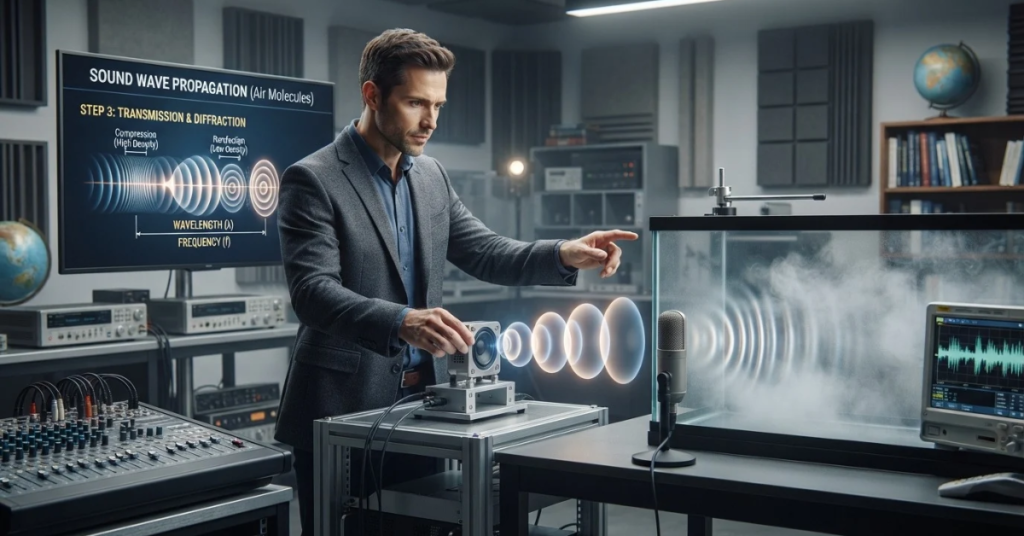
Sound waves travel by passing vibrations from particle to particle through a medium such as air, water, or a solid. Each vibrating particle pushes its neighbor, which creates alternating zones of compression and rarefaction that move outward from the source.
The particles do not travel with the wave. They oscillate back and forth around a fixed position, and only the energy moves forward. In air at 20°C, that disturbance moves at about 343 meters per second (1,235 km/h or 767 mph).
Key takeaways
- Sound needs a medium. It cannot travel through a vacuum.
- Sound is a longitudinal wave. Particles vibrate parallel to the direction the wave travels.
- Speed depends on the medium. Stiffer, less compressible materials carry sound faster, so steel beats water, and water beats air.
- Temperature matters in air. Sound moves faster in warm air than in cold air.
- Frequency does not change speed. It changes wavelength, using the formula v = f × λ.
How Sound Waves Travel, Step by Step
Follow one sound from the source to your ear.
- A source vibrates. A speaker cone, guitar string, or vocal cord moves back and forth.
- It compresses nearby particles. The forward motion squeezes air molecules together, which creates a high-pressure compression.
- Elastic forces push back. The squeezed region expands, and the vibrating source pulls back, which leaves a low-pressure rarefaction behind the compression.
- The pattern repeats and spreads. Each compression and rarefaction passes energy to the next layer of particles, and the wave moves outward in all directions.
- The wave reaches your ear. Pressure changes push and pull your eardrum at the same frequency as the source.
- Your ear converts it into signals. Tiny bones amplify the vibration, the cochlea turns it into nerve impulses, and your brain interprets them as sound.
What Sound Waves Are Made Of
Sound is a mechanical, longitudinal wave. Mechanical means it needs matter to travel through. Longitudinal means the particles move parallel to the wave’s direction, unlike a ripple on water, where the surface moves up and down.
These terms describe every sound wave:
| Term | Meaning | What you hear |
|---|---|---|
| Compression | A region where particles sit close together (high pressure) | The peak of the wave |
| Rarefaction | A region where particles spread apart (low pressure) | The trough of the wave |
| Frequency (Hz) | Wave cycles per second | Pitch |
| Amplitude | The size of the pressure change | Loudness |
| Wavelength (m) | The distance between two compressions | Related to pitch and the size of the space the sound fills |
| Speed (m/s) | How fast the disturbance moves | Delay and echo timing |
The core relationship links speed, frequency, and wavelength:
v = f\lambdaHuman hearing spans roughly 20 Hz to 20,000 Hz. At 20°C, those limits correspond to wavelengths of about 17 meters and 1.7 centimeters.
Why Sound Needs a Medium (and Why Space Is Silent)
Sound moves because particles bump into each other. In a vacuum, no particles exist to carry the vibration, so sound cannot travel.
That is why you would not hear an explosion in the vacuum of space. Radio and light waves differ, because electromagnetic waves do not need a medium.
How Fast Do Sound Waves Travel?
The speed of sound depends on how rigid and how dense the medium is. In general, the more rigid (less compressible) the material, the faster sound moves through it.
| Medium | Speed (m/s) | Why |
|---|---|---|
| Vulcanized rubber | 54 | Soft, absorbs vibration |
| Air at 0°C | 331 | Easily compressed gas |
| Air at 20°C | 343 | Warmer air carries sound faster |
| Helium at 0°C | 965 | Very light gas |
| Fresh water at 20°C | 1,480 | Hard to compress |
| Seawater | 1,540 | Slightly stiffer than fresh water |
| Aluminum | 5,120 | Rigid solid |
| Steel | 5,960 | Very rigid solid |
Why Sound Is Faster in Solids
Solids and liquids resist compression far more than gases do. A stiff material snaps back quickly after a push, so it passes the disturbance along faster.
Density works the other way. For the same stiffness, a denser medium moves more slowly because its particles carry more inertia.
How Temperature Changes the Speed of Sound in Air
Warmer air has faster-moving molecules, so it transmits vibrations more quickly. For air, the speed follows this formula, where T is the absolute temperature in kelvin and v is in meters per second:
v = 331\sqrt{\frac{T}{273}}The result is 331 m/s at 0°C and 343 m/s at 20°C, an increase of less than 4 percent. At 30°C, sound travels at about 349 m/s.
Does Frequency Change the Speed?
No. In air, the speed of sound is nearly independent of frequency across the audible range. A bass note and a high note leave a speaker together and arrive together.
Frequency changes the wavelength instead. A 440 Hz tone (concert A) has a wavelength of about 0.78 meters in 20°C air, because 343 divided by 440 equals 0.78.
How Sound Waves Behave When They Meet Surfaces
Sound waves reflect, bend, wrap around objects, fade, and combine. Each behavior shapes what you hear.
| Behavior | What happens | Everyday example | Where pros use it |
|---|---|---|---|
| Reflection | The wave bounces off a surface | An echo in a canyon or gym | Room treatment and reflection control |
| Refraction | The wave bends as its speed changes | Sound carrying farther over cool water at night | Outdoor concert planning |
| Diffraction | The wave bends around obstacles and through gaps | You hear bass around a corner | Speaker placement and subwoofer design |
| Absorption | The wave’s energy turns into heat | Carpet and curtains deaden a room | Acoustic panels and studio design |
| Interference | Waves add or cancel | Noise-canceling headphones | Active noise control and phase alignment |
| Doppler effect | Pitch shifts when the source or listener moves | An ambulance siren passing by | Radar, ultrasound, and sensing |
Long wavelengths diffract more than short ones. That is why you hear a car’s bass thump through a wall, while the vocals and hi-hats disappear.
How Distance Affects Sound
Sound spreads out as it travels, so its intensity falls with distance. In open space, each doubling of distance drops the sound level by about 6 decibels.
Air also absorbs high frequencies more than low frequencies, so distant sounds seem duller and bassier. This effect explains why thunder rumbles from far away but cracks when it is close.
You can estimate lightning distance with the speed of sound:
- Kilometers: Count the seconds between flash and thunder, then divide by 3.
- Miles: Count the seconds, then divide by 5.
Light reaches you almost instantly, while sound moves about 343 meters every second.
How Sound Travels in Different Environments
In Air
Air is the most common medium, and it carries sound relatively slowly. Temperature, humidity, and wind all change how far and how clearly sound travels.
In Water
Sound travels about four times faster in water than in air, because 1,480 divided by 343 equals about 4.3. A given frequency also has a wavelength about 4.3 times longer in water.
Water absorbs low frequencies less than high ones, which helps some marine animals communicate over long distances.
In Solids
Solids carry sound fastest, and they support more than one wave type. Besides compressional waves, solids also carry shear (transverse) waves, which move more slowly. Earthquakes show both: P-waves are compressional, and S-waves are shear waves.
In Rooms
Indoors, sound reflects off every surface, so you hear the direct sound followed by many reflections. Those reflections create reverberation, and they can also form standing waves at certain frequencies.
Practical Numbers for Audio Engineers and Musicians
These rules of thumb come straight from the speed of sound at 20°C.
- Delay per distance: Sound travels about 34.3 cm (1.13 feet) every millisecond.
- Delay speakers: A delay tower 30 meters from the stage needs about 87.5 ms of delay, because 30 divided by 343 equals 0.0875 seconds.
- Wavelength of low notes: A bass guitar’s low E (about 41.2 Hz) has a wavelength of about 8.3 meters.
- Room modes: The lowest axial mode of a room follows f = v / 2L. For a 4-meter wall-to-wall distance, that gives about 43 Hz.
- Reverberation time: The Sabine formula estimates RT60, the time a sound takes to decay by 60 dB:
RT_{60} = \frac{0.161\,V}{A}Here, V is the room volume in cubic meters, and A is the total absorption in square meters (sabins). More absorption shortens the decay.
- Phase and polarity: Two identical waves in opposite polarity cancel each other, which is the principle behind noise-canceling headphones.
- Comb filtering: A direct sound plus a slightly delayed reflection creates a series of peaks and notches in the frequency response.
Hands-On Demos for Teachers and Students
Try these four classroom or home experiments.
- Slinky waves. Stretch a Slinky and push one end. You will see a compression pulse travel down the coil, which models a longitudinal wave.
- Tuning fork in water. Strike a tuning fork, then touch its tip to a water surface. The splashes show that the prongs vibrate.
- String-cup telephone. Connect two cups with a taut string. Sound travels through the solid string, and you can hear a whisper across the room.
- Echo speed test. Stand a known distance from a large flat wall, clap, and time the echo. Use v = 2d / t. For example, a wall 85 meters away that returns an echo in 0.5 seconds gives 170 divided by 0.5, or 340 m/s.
Common Misconceptions About Sound
- “Particles travel from the source to your ear.” They do not. Particles vibrate in place, and the wave carries the energy.
- “Denser materials always carry sound faster.” Not exactly. Stiffness drives speed, and density slows it down.
- “Louder sounds travel faster.” No. Loudness changes the amplitude, not the speed.
- “High notes outrun low notes.” No. In open air, all audible frequencies travel at the same speed.
- “Sound is a transverse wave.” In air and water, sound is longitudinal. Only solids also support transverse shear waves.
Frequently Asked Questions
How do sound waves travel through the air?
A vibrating source pushes air molecules together and then lets them spread apart. This pattern of compressions and rarefactions moves outward as a longitudinal wave.
Can sound waves travel through a vacuum?
No. Sound needs matter to carry the vibration, and a vacuum contains none.
Does sound travel faster in water or air?
Sound travels faster in water, at about 1,480 m/s for fresh water at 20°C, compared with 343 m/s in 20°C air.
Does sound travel faster in hot or cold air?
Hot air carries sound faster. Sound moves at about 331 m/s at 0°C and 343 m/s at 20°C.
How far can sound travel?
There is no fixed limit. Sound weakens as it spreads and as the medium absorbs it, so distance depends on the loudness, frequency, and conditions. Low frequencies carry farther than high ones.
Why do I see lightning before I hear thunder?
Light travels almost instantly, while sound moves at about 343 m/s. Count the seconds between flash and thunder to estimate the distance.
Is sound a transverse or longitudinal wave?
Sound is longitudinal in gases and liquids. Solids can carry both longitudinal and transverse waves.
Final Thoughts
Sound travels as a chain of pushes and pulls through a medium, so everything about it comes back to the particles passing energy along. Remember the core formula v = f × λ, and you can predict wavelengths, delays, and room behavior.
Try the echo experiment this week, then use the audio rules of thumb to check how sound behaves in your own space.