
Does Light Travel Faster Than Sound? Yes, by About 870,000 Times (With Proof)
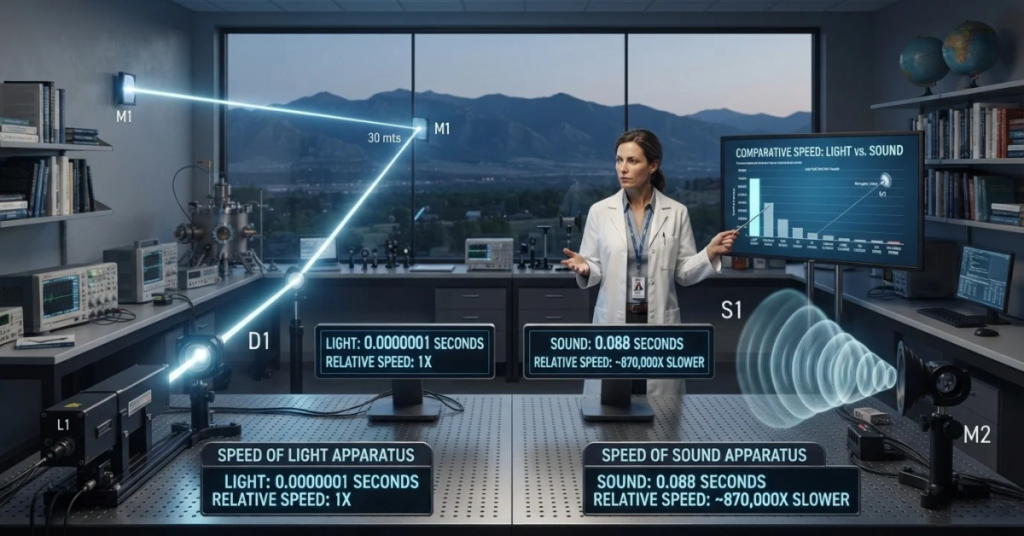
Yes, Does light travel faster than sound. In a vacuum, light moves at exactly 299,792,458 meters per second, while sound in 20°C air moves at about 343 meters per second. That makes light roughly 874,000 times faster.
This gap explains why you see lightning before you hear thunder. It also explains why you see a firework burst before its boom reaches you.
Key takeaways
- Light is far faster. It travels about 299,792 km/s in a vacuum, versus about 0.343 km/s for sound in air.
- The gap holds in every common material. Light also beats sound in water, glass, and air.
- Sound needs matter. It cannot cross empty space, but light can.
- There is one exotic exception. In 1999, scientists slowed light to 17 m/s inside an ultracold gas, slower than sound in air.
- You can use the delay. Count seconds between a flash and a bang to estimate how far away it happened.
Speed Showdown: Light vs. Sound
This table compares both speeds in the same materials. Light slows down inside matter, but it stays far ahead of sound.
| Medium | Light speed | Sound speed | Light is about this many times faster |
|---|---|---|---|
| Air (20°C) | about 299.7 million m/s | 343 m/s | 874,000 |
| Fresh water | about 225 million m/s | 1,480 m/s | 152,000 |
| Glass | about 200 million m/s | 5,640 m/s (Pyrex) | 35,000 |
| Vacuum | 299,792,458 m/s | Sound cannot travel | Not applicable |
Here are the headline speeds in everyday units:
- Light in a vacuum: about 1.08 billion km/h, or 671 million mph
- Sound in 20°C air: about 1,235 km/h, or 767 mph
Light circles Earth about 7.5 times every second. In the time sound crosses a 100-meter football field (about 0.29 seconds), light could travel around Earth more than twice.
Why Is Light So Much Faster Than Sound?
Three reasons explain the gap.
- Light needs no medium. Light is an electromagnetic wave, so it travels through empty space. Sound is a mechanical wave, so it needs particles to pass the vibration along.
- Sound depends on how stiff and dense a material is. The more rigid the medium, the faster sound moves, yet even the stiffest solids carry it at only a few kilometers per second.
- Light’s speed limit is a fundamental constant. The speed of light in a vacuum is the cosmic speed limit, and scientists use it to define the meter.
Since 1983, the meter has been defined as the distance light travels in a vacuum in 1/299,792,458 of a second. That makes the speed of light an exact number.
Everyday Proof You Can See and Hear
You experience this speed gap all the time.
- Lightning and thunder: Both happen at the same instant, but you see the flash first.
- Fireworks: You see the burst, then you hear the boom a moment later.
- Baseball games: A fan far from home plate sees the hit before the crack of the bat reaches them.
- Sprint starts: Many major track meets place speakers behind every starting block, so each runner hears the signal at the same time.
- Concerts: Someone 100 meters from the stage hears the music about 0.29 seconds late, which is why large venues use delay speakers.
How to Estimate Lightning Distance (Flash-to-Bang Method)
Follow these steps during a storm, from a safe place indoors.
- See the flash. Start counting seconds right away.
- Hear the thunder. Stop counting.
- Divide the seconds by 3 to get kilometers, or by 5 to get miles.
For example, a 9-second gap means the lightning struck about 3 kilometers (roughly 2 miles) away. The math works because sound covers about 343 meters per second, or roughly 1 kilometer every 3 seconds.
t = \frac{d}{v}Light covers that same kilometer in about 3.3 millionths of a second, so the flash arrives essentially instantly. If you hear thunder, lightning is close enough to be dangerous, so move indoors.
Mind-Blowing Comparisons
These trips show how large the gap grows over long distances.
| Trip | Light travel time | Sound travel time (hypothetical) |
|---|---|---|
| Across a 100 m field | about 0.3 microseconds | about 0.29 seconds |
| Earth to the Moon (384,400 km) | about 1.3 seconds | about 13 days |
| Sun to Earth (149.6 million km) | about 8 minutes 20 seconds | about 14 years |
Sound cannot actually cross space, so the last two sound times are thought experiments. They show how slow sound would be if a medium carried it the whole way.
Can Sound Ever Beat Light? The One Exception
In everyday conditions, no. Light always wins by an enormous margin, even when it slows down inside water, glass, or diamond.
However, physicists have found a loophole in the lab. In 1999, Lene Hau and her team at Harvard passed a laser pulse through an ultracold gas of sodium atoms and slowed the light to 17 meters per second. That equals about 38 miles per hour, which is much slower than sound in air at 343 m/s.
The researchers published the result in the journal Nature. In 2001, Hau’s team went further and stopped a light pulse inside the atoms completely, then released it again.
The experiment did not break the cosmic speed limit. Light’s speed in a vacuum stayed the same, and the special medium only slowed the pulse inside it.
Does Sound Travel Through Space?
No. Space is nearly a vacuum, so it has too few particles to carry sound waves. Light, radio waves, and other electromagnetic waves cross it easily.
That is why astronauts use radios to talk to each other outside their spacecraft.
Common Misconceptions
- “Lightning and thunder happen at different times.” They happen together. You see the flash first because light arrives first.
- “Light is instant.” Light has a finite speed. It takes about 8 minutes and 20 seconds to reach Earth from the Sun.
- “Light always travels at 299,792,458 m/s.” That number applies to a vacuum. Light slows down in water, glass, and other materials.
- “Sound can travel faster than light in space.” Sound cannot travel through a vacuum at all.
- “Louder sounds travel faster.” Loudness changes the wave’s size, not its speed.
Quick Quiz
Test yourself, then check the answers.
- At a fireworks show, which arrives first, the sight or the sound? The sight, because light is much faster.
- You hear thunder 6 seconds after a flash. How far away was the lightning? About 2 kilometers, or roughly 1.2 miles.
- Could you hear an explosion in space? No. Sound needs matter to travel through.
- What is the one condition where light moved slower than sound? A 1999 lab experiment with an ultracold gas slowed light to 17 m/s.
Frequently Asked Questions
Does light travel faster than sound?
Yes. Light moves at 299,792,458 m/s in a vacuum, while sound moves at about 343 m/s in 20°C air, so light is roughly 874,000 times faster.
How much faster is light than sound?
In air, light is about 874,000 times faster. In water, the ratio is about 152,000, and in glass it is about 35,000.
Why do we see lightning before we hear thunder?
Lightning and thunder start together, but light reaches you almost instantly, while sound takes about 3 seconds per kilometer.
Is there anything faster than light?
Nothing with mass can match light’s speed in a vacuum, and no information can travel faster than it.
Can light travel through space but sound cannot?
Yes. Light is an electromagnetic wave and needs no medium, while sound needs particles to carry it.
Has light ever been slower than sound?
Yes, in a 1999 Harvard experiment, researchers slowed light to 17 m/s inside an ultracold atomic gas. That is slower than sound in air.
How long does light take to reach Earth from the Sun?
About 8 minutes and 20 seconds.
Final Thoughts
Light beats sound by a huge margin because it needs no medium and moves at the universe’s speed limit, while sound crawls through matter at a few hundred meters per second.
The next time a storm rolls in, count the seconds between flash and bang, and you will measure that difference yourself.