
How Long Does It Take to Travel a Light Year? The Real Numbers
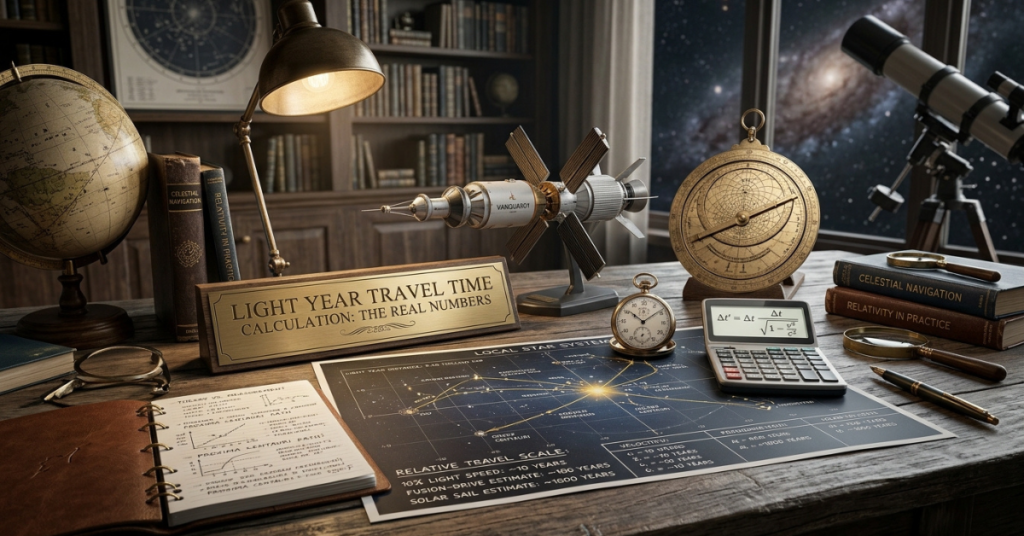
Light How Long Does It Take to Travel a Light Year, and nothing we’ve built comes close to matching that. At Voyager 1’s speed, the trip would take about 18,000 years. At the speed of the Parker Solar Probe, the fastest spacecraft ever built, it would take roughly 1,560 years.
The timing is perfect for this question. On Wednesday, November 18, 2026, Voyager 1 becomes the first spacecraft to reach one light-day from Earth. That’s one 365th of a light year, and it took the probe more than 49 years.
Quick Answer: Travel Time for One Light Year
| Traveler | Speed | Time to Cover 1 Light Year |
|---|---|---|
| Light | About 299,792 km/s | 1 year |
| Parker Solar Probe (record, near the Sun) | 192.22 km/s (692,000 km/h) | About 1,560 years |
| Apollo 10 crew (fastest crewed speed) | About 39,897 km/h | About 27,000 years |
| Voyager 1 | About 61,155 km/h (38,000 mph) | About 18,000 years |
My calculations use one light year as about 9.461 trillion kilometers. Values are rounded and assume constant speed.
What Is a Light Year?
A light year measures distance, not time. It’s the distance light covers in one year in a vacuum. A light-year equals 365.25 light-days, or about 9.461 trillion kilometers.
Smaller units help with scale. A light-second is about 300,000 km, and the Sun is about 8.3 light-minutes from Earth. A light-day is about 25.9 billion km.
Voyager 1: Our Light-Day Reality Check
Voyager 1 launched in 1977 and now flies through interstellar space. NASA says it will reach a distance of 16.09 billion miles (25.89 billion kilometers) from Earth on November 18, which equals one light-day.
The trip took a long time. Voyager 1 needed 49 years, 2 months and 11 days to cover that distance. A light year is 365 times further than a light-day. At this speed, that gives roughly 18,000 years.
The probe also shows how slowly we move compared with light. Voyager 1 travels at about 17 km/s, or 0.006% of the speed of light.
Parker Solar Probe: Our Fastest Spacecraft
The Parker Solar Probe holds the speed record. It reached 192.22 km/s (692,000 km/h) at 11:53 UTC on December 24, 2024, at its closest approach to the Sun after a Venus gravity assist.
That record has limits. Parker is not an interstellar spacecraft, and it cannot carry that solar-encounter speed into deep space. Even if it could, its peak speed is only about 0.064% of light speed. Our best case still means over 1,500 years per light year.
Calculate Light-Year Travel Time Yourself
Use this simple method for any speed.
- Find your speed as a fraction of light speed. Divide your speed by 299,792 km/s.
- Divide 1 by that fraction. The result is the travel time in years, as seen from Earth.
- Multiply by the number of light years for longer trips.
Example: Parker’s 192.22 km/s equals 0.00064 of light speed. One divided by 0.00064 gives about 1,560 years.
Travel Time at Different Fractions of Light Speed
| Speed | Time for 1 Light Year (Earth Frame) |
|---|---|
| 1% of light speed | 100 years |
| 10% | 10 years |
| 20% | 5 years |
| 50% | 2 years |
| 99% | About 1.01 years |
These figures ignore acceleration and braking, which add time and energy cost in any real mission.
Time Dilation: Why Ship Time Differs From Earth Time
Einstein’s relativity changes the story near light speed. Clocks on a fast spaceship tick slower than clocks on Earth. This is a standard result of special relativity, calculated below.
| Ship Speed | Earth Time for 1 Light Year | Ship Time for 1 Light Year |
|---|---|---|
| 50% of light speed | 2.0 years | About 1.7 years |
| 90% | About 1.1 years | About 177 days |
| 99% | About 1.01 years | About 52 days |
| 99.9% | About 1.001 years | About 16 days |
Calculated from the Lorentz factor. Travelers feel less time pass, while observers on Earth still wait more than a year.
Why We Can’t Just Go Faster
Energy is the main barrier. Accelerating one ton to one-tenth of the speed of light requires at least 450 petajoules, or about 125 terawatt-hours. That’s before you add fuel to stop, shield against dust or carry people.
Speed also has an absolute cap. Objects with mass cannot reach the speed of light. Faster-than-light ideas such as warp drives remain theoretical, with no known way to build them.
What About Breakthrough Starshot?
One concept offers a shortcut for tiny probes. Breakthrough Starshot proposes using powerful ground-based lasers to push gram-scale spacecraft attached to reflective sails, targeting up to 20 percent of light speed. That would reach Alpha Centauri in a little over 20 years. The idea is an unbuilt concept, so treat it as a possibility, not a plan.
How Long to Reach the Nearest Star?
Proxima Centauri sits about 4.24 light years away. The travel time depends on who flies.
| Traveler | Time to Proxima Centauri |
|---|---|
| Light | 4.24 years |
| Starshot concept (20% of light speed) | A little over 20 years |
| Parker’s peak speed | About 6,600 years |
| Chemical rockets (published estimate) | About 70,000 years |
| Voyager 1’s speed | Approaching 75,000 years |
Sci-Fi vs. Reality
Movies compress light years into minutes with hyperdrives. Real physics doesn’t allow it with any known technology.
- Sci-fi: Ships jump across light years in hours.
- Reality: Our fastest craft would need centuries to cover one light year.
- Middle ground: Tiny laser-sail probes may reach the nearest star within decades, but only as a proposal.
FAQ: How Long Does It Take to Travel a Light Year?
How long does it take light to travel a light year?
One year, by definition.
How long would it take Voyager 1 to travel a light year?
About 18,000 years at its current speed.
How long would the Parker Solar Probe take?
Roughly 1,560 years at its peak speed, though it can’t actually maintain that speed outside the Sun’s gravity well.
Is a light year a measure of time?
No. It measures distance, about 9.461 trillion kilometers.
Could humans ever travel a light year in a lifetime?
Not with today’s technology. A traveler at 99% of light speed would age only about 52 days, but no known propulsion can reach that speed.
How far is a light day?
About 25.9 billion kilometers, and Voyager 1 reaches it on November 18, 2026.
The Takeaway
A light year takes one year for light, about 1,560 years at our best spacecraft speed and about 18,000 years at Voyager 1’s pace. Use one divided by your speed as a fraction of light speed to find any travel time. The gap between those numbers shows how far interstellar flight remains from today’s engineering.
Spacecraft speeds change with orbits and measurement frames, and the travel times above are rounded estimates assuming constant speed. I calculated the travel-time and time-dilation figures from published values, and they aren’t mission predictions. I can also turn this into a Word doc or an HTML page, or write a classroom version with practice problems.