
How Fast Do Satellites Travel? Complete Q&A Guide
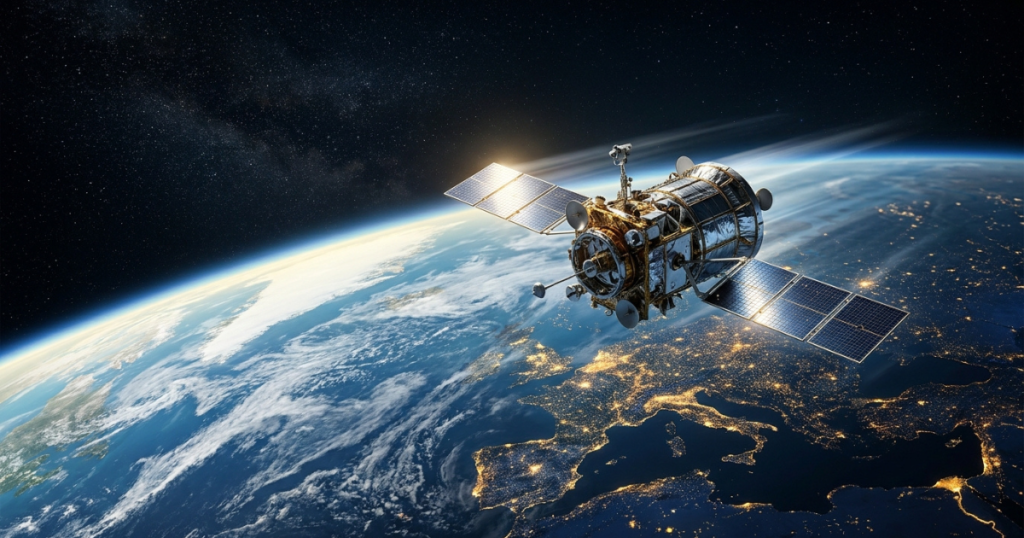
How Fast Do Satellites Travel?
Satellites in low Earth orbit travel about 7.6 to 7.8 kilometers per second, which is roughly 27,000 to 28,000 km/h (17,000 mph). Higher satellites move slower, and geostationary satellites travel only about 3.07 km/s.
Key summary: A satellite’s speed depends on its altitude, not its size or weight. Lower orbits demand higher speeds. NASA lists the International Space Station at about 17,500 mph (28,000 km/h), and it circles Earth every 90 minutes. GPS satellites cruise near 3.9 km/s, and geostationary satellites near 3.07 km/s.
What is the average speed of a satellite?
There is no single average, because every orbit has its own speed. Low Earth orbit satellites move at about 7 to 8 km/s, medium Earth orbit satellites at roughly 3 to 7 km/s, and geostationary satellites at about 3 km/s.
Most working satellites fly in low Earth orbit, below about 2,000 km. Trackers count roughly 16,000 to 17,000 active satellites in October 2026, and about nine in ten of them orbit in this fast, low band. Because so many satellites are Starlink craft at around 550 km, a typical satellite today moves close to 7.6 km/s.
How fast does the International Space Station travel?
The International Space Station travels at about 28,000 km/h (17,500 mph), according to NASA figures. It completes one lap of Earth about every 90 minutes, which gives the crew 16 sunrises and 16 sunsets every day.
The station flies about 400 to 420 km above Earth. Using the orbital speed formula, a circular orbit at roughly 420 km works out to about 7.66 km/s, or about 17,100 mph. The widely quoted 17,500 mph is a rounded figure, so you will see both numbers in reliable sources.
How do you convert satellite speeds into everyday units?
Multiply kilometers per second by 3,600 to get kilometers per hour, and by 2,237 to get miles per hour. A speed near 7.66 km/s equals about 27,600 km/h, 17,100 mph and 22 times the speed of sound at sea level.
| Unit | International Space Station (about 7.66 km/s) |
|---|---|
| Kilometers per second | 7.66 |
| Kilometers per hour | About 27,600 |
| Miles per hour | About 17,100 |
| Miles per second | About 4.8 |
| Multiples of the speed of sound (Mach) | About 22 |
That speed is fast by human standards, but it is tiny next to light. The ISS moves at roughly one forty-thousandth of the speed of light.
Why Does a Satellite’s Speed Depend on Its Altitude?
Gravity weakens with distance, so a higher satellite needs less sideways speed to stay in orbit. For a circular orbit, speed falls as the orbit grows, following the formula v = √(GM/r).
What is the formula for orbital speed?
For a circular orbit, orbital speed equals the square root of Earth’s gravitational parameter divided by the orbital radius. The radius is measured from Earth’s center, so you add Earth’s radius to the satellite’s altitude.
v = \sqrt{\frac{GM}{r}}- v is the orbital speed.
- GM is Earth’s gravitational parameter, about 398,600 km³/s² (G times Earth’s mass of about 5.97 × 10²⁴ kg).
- r is the distance from Earth’s center, which equals Earth’s radius of about 6,371 km plus the altitude.
The period of one orbit follows from speed and distance. A satellite travels one circumference, 2πr, at speed v.
T = \frac{2\pi r}{v} = 2\pi\sqrt{\frac{r^{3}}{GM}}How do you calculate the speed of the ISS step by step?
Add the station’s altitude to Earth’s radius, divide 398,600 by that radius, and take the square root. At about 420 km, the result is roughly 7.66 km/s, and the period is about 93 minutes.
- Find the radius: r = 6,371 km + 420 km = 6,791 km.
- Divide: 398,600 ÷ 6,791 ≈ 58.7.
- Take the square root: √58.7 ≈ 7.66 km/s.
- Convert: 7.66 km/s × 3,600 ≈ 27,600 km/h, or about 17,100 mph.
- Find the period: T = 2π × 6,791 ÷ 7.66 ≈ 5,570 seconds, which is about 93 minutes.
NASA rounds the station’s orbit to about 90 minutes, and the small difference reflects its changing altitude and rounding.
Does a heavier satellite travel faster?
No. A satellite’s mass cancels out of the orbital speed equation, so two satellites at the same altitude travel at the same speed, whether one weighs a few kilograms or several tons. Only the orbit’s radius matters.
This is why astronauts, tools and the station itself drift together at the same speed. They all fall around Earth along the same path.
Why do higher satellites move slower?
Gravity gets weaker as you move away from Earth, so a higher satellite needs less speed to keep missing the planet. It also has a much longer path to travel, which makes its orbital period grow quickly with altitude.
The result feels backward at first. A geostationary satellite at 35,786 km moves at only about 3.07 km/s, yet it takes almost 24 hours to complete a lap. A satellite at 420 km moves at more than twice that speed and finishes a lap in about 93 minutes.
Do satellites change speed in an elliptical orbit?
Yes. In an elliptical orbit, a satellite moves fastest at its closest point to Earth, called perigee, and slowest at its farthest point, called apogee. Kepler’s second law describes this change.
Highly elliptical orbits show the effect clearly. Satellites in these orbits can range from about 1.5 km/s to about 10 km/s over one lap, depending on where they are. Such orbits suit communication and remote-sensing missions that need long dwell time over high latitudes.
Why does a satellite speed up when its orbit decays?
Atmospheric drag removes energy, which pulls the satellite into a lower orbit, and a lower orbit requires a higher speed. Drag seems like a brake, but the satellite actually ends up moving faster as it sinks.
Even at 400 km, a thin atmosphere creates drag. The ISS loses several kilometers of altitude per month, so docked spacecraft periodically fire their engines to push it back up.
How Fast Do Satellites Travel in Each Type of Orbit?
Satellites in low Earth orbit move at roughly 7 to 8 km/s, medium Earth orbit satellites at about 3 to 7 km/s, and geostationary satellites at 3.07 km/s. Speed falls steadily as the orbit rises.
[embed: node/115b4d07-bbb5]
The curve drops quickly at first and then flattens. Doubling the altitude of a low orbit trims the speed only slightly, but climbing from GPS height to geostationary height removes roughly 0.8 km/s.
What are the main types of Earth orbit?
Earth orbits fall into four groups: low (LEO), medium (MEO), geostationary (GEO) and highly elliptical (HEO). Each group has its own altitude range, period and speed, and each suits different missions.
| Orbit | Altitude | Orbital period | Typical speed | Typical uses |
|---|---|---|---|---|
| Low Earth orbit (LEO) | 160 to 2,000 km | About 88 to 127 minutes | About 7.8 down to 6.9 km/s | ISS, Earth imaging, Starlink |
| Medium Earth orbit (MEO) | 2,000 to 35,786 km | About 2 to 24 hours | About 6.9 down to 3.07 km/s | GPS and other navigation systems |
| Geostationary orbit (GEO) | 35,786 km | 23 hours, 56 minutes | About 3.07 km/s | TV broadcasting, weather, communications |
| Highly elliptical orbit (HEO) | Varies widely | About 12 to 24 hours | About 1.5 to 10 km/s | Communications, satellite radio, remote sensing |
Sources draw the boundary between low and medium orbit near 2,000 km, though some references use slightly different limits.
How fast do GPS satellites travel?
GPS satellites fly about 20,200 km above Earth at roughly 3.9 km/s, or about 14,000 km/h. Each satellite completes one orbit in about 12 hours, so it circles Earth twice a day.
The constellation spreads at least 24 satellites over six orbital planes, which keeps at least four in view from almost anywhere. A receiver needs four signals to solve for position and correct its clock.
Why are most satellites in low Earth orbit?
About nine in ten active satellites fly in low Earth orbit, because it is cheaper to reach, closer to the ground and well suited to big constellations such as Starlink. Low orbits do demand the highest orbital speeds.
As of October 2026, one tracker counted about 20,290 satellites in orbit, with about 16,800 working and about 17,781 in low Earth orbit. Starlink alone made up nearly two of every three working satellites.
What is the difference between geostationary and geosynchronous orbit?
A geosynchronous orbit has a period of one sidereal day, while a geostationary orbit is a special geosynchronous orbit that is circular and sits directly above the equator. Only geostationary satellites appear fixed in the sky.
Both orbits sit at about 35,786 km and move at about 3.07 km/s. A geosynchronous satellite on a tilted path traces a figure-eight over the ground instead of holding still.
How long does one orbit take?
The ISS takes about 90 minutes, a Starlink satellite about 95 minutes, a GPS satellite about 12 hours, and a geostationary satellite 23 hours and 56 minutes. Higher orbits take longer, because the satellite travels a longer path.
Why Don’t Satellites Fall, and How Do They Reach Orbital Speed?
Why don’t satellites fall to Earth?
Satellites do fall. An orbit is continuous free fall in which a satellite moves sideways fast enough that Earth’s curved surface keeps dropping away beneath it, so the satellite keeps missing the ground.
Gravity does not disappear in space. It constantly bends the satellite’s path toward Earth, and the satellite’s sideways speed carries it forward. The two effects combine into a curved path around the planet.
What is Newton’s cannonball thought experiment?
Isaac Newton imagined firing a cannonball horizontally from a very tall mountain. A slow shot lands nearby, a faster shot lands farther away, and a shot fast enough never lands, because Earth curves away as quickly as the ball falls.
The table shows what happens at different horizontal speeds near Earth’s surface, ignoring air resistance.
| Horizontal speed | Result |
|---|---|
| Below about 7.9 km/s | The ball falls back to Earth |
| About 7.9 km/s | The ball follows a circular orbit |
| Between about 7.9 and 11.2 km/s | The ball follows an elliptical orbit |
| About 11.2 km/s or more | The ball escapes Earth’s gravity |
How do rockets get satellites up to orbital speed?
Rockets climb out of the thickest air first, then tilt and spend most of their energy building sideways speed. Reaching a high altitude alone does not create an orbit. A rocket that only goes up falls straight back down.
Launch sites near the equator get a small speed boost for free, because Earth’s surface rotates eastward at about 0.46 km/s there. Rockets launched eastward add that speed to their own, which saves fuel.
What is escape velocity, and how does it compare with orbital speed?
Escape velocity is the speed an object needs to leave Earth’s gravity completely, about 11.2 km/s or roughly 40,270 km/h at the surface. It equals the square root of 2 times the circular orbital speed at the same height.
A satellite already in a circular orbit needs a speed boost of about 41 percent to escape, whatever the altitude. That is why planetary probes use powerful upper stages after they reach orbit.
Why do astronauts float if gravity is still strong?
Astronauts float because they and their spacecraft fall around Earth together. Gravity at the station’s altitude is still about nine-tenths as strong as it is on the ground, so the crew is in free fall, not in zero gravity.
Everything inside the station accelerates toward Earth at the same rate, so nothing pushes against anything else. That is the feeling of weightlessness.
Why does a geostationary satellite look motionless?
A geostationary satellite orbits once every 23 hours, 56 minutes and 4 seconds, which matches Earth’s rotation. It really moves at about 3.07 km/s, but it stays above the same spot on the equator, so it seems to hover.
Only one altitude gives this match: about 35,786 km above the equator. The orbit must also be circular and exactly above the equator. That is why geostationary satellites for any country sit along the equator, not above their own territory.
What happens to satellites at the end of their lives?
Low satellites eventually sink into the atmosphere and burn up, while high satellites move to disposal orbits. Drag pulls low orbits down over time, and operators deorbit many satellites on purpose. Retired geostationary satellites move to a higher graveyard orbit.
The ISS shows the balance. It loses several kilometers of altitude per month, so it needs regular reboosts from docked spacecraft to keep its orbit.
How Does Satellite Speed Compare With Everyday Speeds?
How does the speed of a satellite compare with a jet or a bullet?
A low-orbit satellite moves about 30 times faster than a commercial jet and roughly 8 to 10 times faster than a rifle bullet. It still travels far slower than light, which moves about 40,000 times faster than the ISS.
The table uses the ISS at about 27,600 km/h as the benchmark. Jet and bullet speeds are typical approximate values.
| Object | Approximate speed (km/h) | Compared with the ISS |
|---|---|---|
| Commercial jet | 900 | About 30 times slower |
| Speed of sound at sea level | 1,235 | About 22 times slower |
| Rifle bullet | 3,000 | About 9 times slower |
| International Space Station | 27,600 | Benchmark |
| Parker Solar Probe, record speed | 692,000 | About 25 times faster |
| Light in a vacuum | 1,079,000,000 | About 39,000 times faster |
How long would a satellite take to cross the United States?
At about 7.66 km/s, a low-orbit satellite would cover the roughly 3,940 km from New York to Los Angeles in about 8 to 9 minutes. A commercial jet needs about 5 to 6 hours for the same trip.
The ISS travels farther than that. It flies about 42,700 km per orbit, and it completes about 16 orbits a day. That adds up to roughly 680,000 km daily, which is close to a round trip between Earth and the Moon.
What is the fastest human-made object?
NASA’s Parker Solar Probe holds the record. On December 24, 2024, it passed within 6.1 million km (3.8 million miles) of the Sun’s surface at about 692,000 km/h (430,000 mph), faster than any human-made object has ever moved.
That speed equals about 0.064 percent of the speed of light. It would carry the probe from Tokyo to Washington, D.C., in under a minute. The probe is not an Earth satellite, and its speed is measured relative to the Sun. It reaches the record at the closest point of its stretched orbit, where the Sun’s gravity pulls it fastest.
Can you see satellites moving with your own eyes?
Yes. The ISS appears as a bright, steady dot that crosses the sky in a few minutes, and Starlink satellites often appear as a line of moving lights soon after launch. NASA’s Spot the Station service lists local viewing times.
The sky crossing looks slow because the satellite is hundreds of kilometers away. A speed of 7.66 km/s covers a small angle of the sky at that distance, so even the fast ISS seems to glide.
How fast does the Moon, a natural satellite, travel?
The Moon travels at about 1 km/s, or roughly 3,700 km/h, in its orbit about 384,400 km away. That is far slower than the ISS, because the Moon sits far above any satellite and Earth’s gravity is much weaker there.
The same orbital speed formula works for both. Put in the Moon’s distance, and the result is about 1.02 km/s.
Student and Teacher Corner: Practice, Myths and Quick Facts
How can students practice calculating satellite speed?
Use v = √(398,600 ÷ r), with r in kilometers from Earth’s center, and T = 2πr ÷ v for the period. Try the three problems below, then check each answer with the quick solution.
| Problem | Quick solution |
|---|---|
| A satellite orbits 1,000 km above Earth. Find its speed and period. | r = 7,371 km, so v ≈ 7.35 km/s and T ≈ 105 minutes |
| A satellite orbits at a height equal to Earth’s radius. Find its speed. | r = 12,742 km, so v ≈ 5.6 km/s and T ≈ 4 hours |
| A satellite orbits at one-quarter of the geostationary radius. Find its speed and period. | Speed doubles to about 6.1 km/s, and the period shrinks to one-eighth, about 3 hours |
The third problem uses a scaling rule: speed varies as 1 ÷ √r, and the period varies as r to the power of 1.5. Quartering the radius doubles the speed and divides the period by eight.
What are the most common satellite speed myths?
The biggest myths are that satellites float without gravity, that geostationary satellites do not move, and that higher satellites go faster. Each one reverses the real physics, so addressing them early helps students.
| Myth | Reality |
|---|---|
| Satellites float because space has no gravity | Gravity is strong at orbital height, and satellites are in free fall |
| Geostationary satellites are not moving | They move at about 3.07 km/s but match Earth’s rotation |
| Higher satellites move faster | Higher satellites move slower and take longer to orbit |
| Heavier satellites orbit slower | Mass cancels, so only altitude sets orbital speed |
| All satellites travel at 17,500 mph | That figure fits the ISS, and other orbits have other speeds |
| Satellites need engines to keep moving | They keep moving without thrust, and engines only correct drag and position |
What classroom activities show how orbital speed works?
Students learn fastest by seeing Newton’s cannonball in action, tracking real satellites and calculating periods themselves. These activities need little equipment, and each one ties directly to the formulas above.
- Run a cannonball simulation. The American Museum of Natural History and The Physics Classroom both offer animations that show launch speeds from falling to circular to elliptical.
- Track the ISS. Use NASA’s Spot the Station to find local viewing times, then time how long the station takes to cross the sky.
- Build a spreadsheet. Let students enter altitudes and compute speed, period and orbits per day.
- Compare orbit types. Ask students to predict which orbit is fastest before they calculate it.
- Debate the paradox. Why does a lower satellite move faster but a higher one take longer to finish a lap?
Which satellite speed facts work best for trivia?
The ISS, the geostationary belt, escape velocity and the Parker Solar Probe give the strongest trivia hooks. Each has a memorable number and a clear reason behind it.
- The ISS moves at about 28,000 km/h and circles Earth 16 times a day.
- A geostationary satellite moves at about 3.07 km/s yet looks motionless.
- Escape velocity from Earth is about 11.2 km/s, or roughly 40,270 km/h.
- The Parker Solar Probe reached about 692,000 km/h in December 2024.
- Satellites need no engine to keep moving, only to correct drag and position.
Frequently Asked Questions
How fast do satellites travel in mph?
Low Earth orbit satellites travel about 17,000 mph, GPS satellites about 8,700 mph, and geostationary satellites about 6,900 mph. Speed falls as altitude rises.
How fast does Starlink travel?
Starlink satellites orbit about 550 km up and travel about 7.6 km/s, which is roughly 27,300 km/h or 17,000 mph. Each one circles Earth in about 95 minutes.
How fast does a GPS satellite travel?
A GPS satellite flies about 20,200 km up at roughly 3.9 km/s, or about 14,000 km/h. It completes one orbit in about 12 hours, so each satellite circles Earth twice a day.
How many times does the ISS orbit Earth in a day?
The ISS completes about 16 orbits a day, so the crew sees 16 sunrises and 16 sunsets every 24 hours.
Can a satellite go faster than orbital speed?
Yes, but its orbit changes. A satellite above circular speed moves onto an elliptical path, and one that reaches about 11.2 km/s at Earth’s surface can escape Earth’s gravity.
Do satellites ever stop moving?
No. A satellite in orbit keeps moving unless drag, a deliberate deorbit burn or a collision ends its orbit. Even geostationary satellites move, and they only look still.
Sources and Methods
This guide reflects information available on November 16, 2026. I compiled it from search results and did not open every page, so some figures come from search excerpts. Orbital speeds for the specific altitudes were calculated with v = √(GM/r), using GM = 398,600 km³/s² and Earth’s radius of 6,371 km. Real satellites change altitude, so actual speeds vary slightly. Satellite counts change daily.
- Phys.org: ISS completes 100,000th orbit
- Kennedy Space Center: ISS frequently asked questions
- Space.com: International Space Station overview
- Space.com: How the ISS stays in orbit
- U.S. Centennial of Flight: Geosynchronous orbit
- Electronics Notes: Satellite facts
- SparkFun: Understanding GNSS orbits
- The Cavalier: Satellite orbits and orbital speed
- Orbital Radar: Why GEO hovers
- Johns Hopkins: Parker Solar Probe closest pass
- Science News: Parker Solar Probe survived its closest approach
- Live Science: Parker Solar Probe flyby
- KeepTrack: How many satellites are in space
- The Physics Classroom: Satellite motion
- American Museum of Natural History: Newton’s ball
- RevisionDojo: Why satellites do not fall
- EUROAVIA: Satellite orbits and gravity