
Does Light Travel in a Straight Line? The Short Answer and the Surprising Exceptions
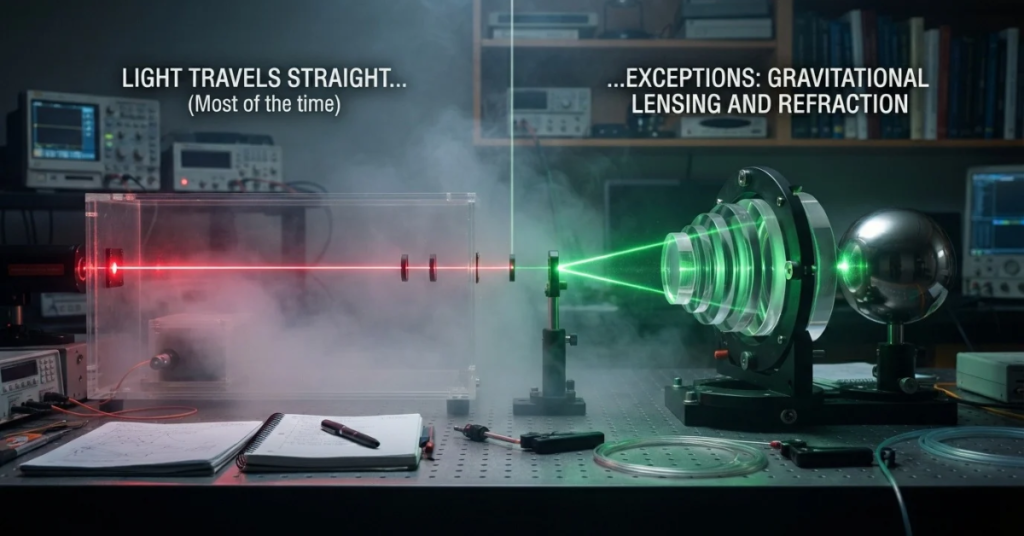
Yes, Does light travels in a straight line through a uniform medium, including empty space far from strong gravity. That is why shadows have sharp edges and a laser beam looks like a line.
But light does not always travel straight. It bends when it passes from one material to another (refraction), reflects off surfaces, spreads around edges (diffraction), and curves around massive objects like stars and galaxies (gravitational lensing). Even in those cases, light follows the straightest possible path available.
Key Takeaways
- In one uniform medium, light goes straight. This is the law of rectilinear propagation.
- Light bends at boundaries. Refraction changes its direction when its speed changes, such as when it enters water or glass.
- Light also spreads and reflects. Diffraction and reflection change what light does near edges and surfaces.
- Gravity bends light’s path. Starlight passing the Sun in 1919 shifted by about 1.75 arcseconds, as Einstein predicted.
- Photographers use both ideas. Straight-line behavior gives you shadows, and bending gives you lenses.
Quick Answer: When Does Light Travel in a Straight Line?
Use this table to see how light behaves in common situations.
| Situation | Does light travel straight? | What happens |
|---|---|---|
| Through empty space with no nearby mass | Yes | Light moves in a straight line |
| Through air, water, or glass of uniform density | Yes | Light moves straight inside each material |
| At the boundary between two materials | No | Refraction changes its direction |
| Off a mirror or shiny surface | No | Reflection changes its direction |
| Past a narrow slit or sharp edge | Not exactly | Diffraction spreads the light |
| Near a massive object | Curved as seen from far away | Gravity bends the light’s path |
| Through air of changing temperature | No | Gradual refraction creates mirages |
Why We Say Light Travels in Straight Lines
Scientists call this behavior rectilinear propagation. Everyday evidence backs it up.
- Shadows have clear shapes. Light blocked by an object cannot bend around it, so the shadow matches the object.
- Pinhole cameras work. Light rays pass through a tiny hole and form an inverted image because they travel straight.
- Laser beams look like lines. The beam stays narrow over long distances in clear air.
- Eclipses follow geometry. The Moon blocks sunlight along straight paths, which creates the Moon’s shadow on Earth.
- Light shafts through haze or trees. You can see straight beams when dust or fog scatters the light toward your eyes.
When Light Does Not Travel in a Straight Line
1. Reflection
When light hits a surface, it bounces. For a smooth mirror, the angle of incidence equals the angle of reflection.
Each segment of the path stays straight, but the overall path changes direction.
2. Refraction
Light changes speed when it moves between materials, and that speed change bends its path. In a vacuum, light travels at about 299,792,458 meters per second. In water it moves at roughly three-quarters of that speed, and in glass it moves at roughly two-thirds.
Snell’s law describes the bending: n₁ sin θ₁ = n₂ sin θ₂. The letter n stands for the refractive index of each material.
| Material | Approximate refractive index | Approximate light speed |
|---|---|---|
| Vacuum | 1.00 | About 300,000 km/s |
| Air | 1.0003 | Almost the same as vacuum |
| Water | 1.33 | About 75% of vacuum speed |
| Glass | About 1.5 | About 67% of vacuum speed |
| Diamond | About 2.42 | About 41% of vacuum speed |
Everyday examples of refraction:
- A straw in a glass looks bent at the water line.
- A swimming pool looks shallower than it is.
- Lenses in glasses, cameras, and telescopes focus light.
3. Atmospheric Refraction and Mirages
Air density changes with temperature and height, so light bends gradually as it passes through layers of air. Several effects follow.
- Sunsets last longer. Atmospheric refraction lifts the Sun’s image, so you still see it after it has dipped below the horizon geometrically.
- Stars twinkle. Turbulent air bends starlight slightly and unevenly.
- Mirages appear on hot roads. Light from the sky bends upward through a layer of hot air, so the road seems to shimmer with water.
4. Diffraction
Light behaves like a wave, and waves spread when they pass through narrow openings or around edges. This effect is called diffraction.
Diffraction is small for large objects, which is why everyday shadows look sharp. It becomes noticeable when openings are close to the wavelength of light, roughly 400 to 700 nanometers for visible light.
5. Scattering
Particles in the air scatter light in many directions. Scattering explains why the daytime sky looks blue and why sunbeams become visible in mist or smoke.
Scattering changes the direction of individual light rays, but it does not bend a single beam smoothly.
6. Gravitational Lensing
Einstein’s general theory of relativity predicts that mass curves spacetime, and light follows that curvature. From far away, the light’s path looks bent.
In 1915, Einstein calculated that starlight grazing the Sun should shift by about 1.75 arcseconds. During the total solar eclipse of May 29, 1919, Arthur Eddington and his collaborators measured shifts consistent with that prediction. Expeditions observed the eclipse from Principe, off the coast of West Africa, and from Sobral, Brazil. Newer analyses of the old plates have refined the numbers, with a 1979 re-measurement of the Sobral plates giving about 1.55 arcseconds, plus or minus 0.32.
Today, astronomers use gravitational lensing to study galaxies and dark matter. Massive galaxy clusters act as lenses that distort and magnify the light of galaxies behind them.
Straight, in a curved space: Physicists say light follows a geodesic, the straightest path available in curved spacetime.
7. Light Guided Through Fiber Optics
Optical fibers trap light by total internal reflection, so it follows bends in a cable. The light still travels in straight segments, but it keeps reflecting off the fiber’s walls.
Fermat’s Principle: The Idea That Ties It Together
Fermat’s principle says light follows the path that takes the least time, or more precisely, a path where the travel time is stationary.
In a uniform material, the quickest route is a straight line. At a boundary, light bends so the total travel time between two points is as short as possible.
Think of a lifeguard running along sand and then swimming. The lifeguard runs farther on sand because swimming is slower, which bends the path at the water’s edge. Light does the same thing when it enters glass or water.
Ray Model vs. Wave Model
Scientists describe light in more than one way.
| Model | Best for | What it explains |
|---|---|---|
| Ray model | Shadows, mirrors, lenses, cameras | Straight-line travel, reflection, refraction |
| Wave model | Diffraction, interference, polarization | Spreading, patterns, and colors from thin films |
| Photon (quantum) model | Light and matter interactions | How light is emitted and absorbed |
| General relativity | Strong gravity | Bending around stars and galaxies |
The ray model works well when objects are much larger than light’s wavelength. Switch to the wave model when features get very small.
Simple Experiments to Test Light’s Path
You can see these effects at home or in class.
- Three-card test. Punch a hole at the same height in three cards. Line them up in front of a flashlight. Light passes through only when the holes sit in a straight line.
- Shadow measurement. Hold an object in front of a lamp and measure the shadow at different distances.
- Pinhole camera. Poke a small hole in one side of a box and tape wax paper on the opposite side. Point the hole at a bright scene, and look for an upside-down image.
- Bent straw. Put a straw in a glass of water and look from the side.
- Laser in water. Add a drop of milk to a clear tank of water, then shine a laser through it to see the beam bend at the surface. Never point a laser at anyone’s eyes.
Does Light Travel in a Straight Line? Notes for Photographers and Cinematographers
The straight-line behavior of light shapes your work.
| Light behavior | What you see | Practical tip |
|---|---|---|
| Straight-line travel | Shadows with defined edges | Move a flag or gobo to shape where shadows fall |
| Source size and distance | Hard or soft shadow edges | Use a larger or closer source for softer light |
| Inverse square law | Light falls off quickly with distance | Doubling the distance gives one-quarter the light |
| Reflection | Bounce light and glare | Use reflectors to fill shadows, and polarizers to cut glare |
| Refraction | Lenses focus light | Choose lenses for the field of view and depth of field you need |
| Diffraction | Softness at very small apertures | Avoid extremely small apertures when you need maximum sharpness |
| Scattering | Visible light beams in haze or fog | Add haze to show beams and create atmosphere |
| Heat refraction | Shimmer over hot surfaces | Expect distortion in long telephoto shots over hot ground |
Lighting Tips Based on Light’s Straight-Line Behavior
- Think in rays. Imagine straight lines from your source to your subject to predict shadows.
- Use distance for control. Move the light closer for more falloff, or farther for more even exposure.
- Shape the light with flags, grids, and barn doors. These tools block rays in straight paths.
- Add haze deliberately. Particles scatter the light, so beams become visible on camera.
- Watch for flare. Light reflecting between lens elements can create flare, so use a lens hood.
Study Notes for Science Students
Key terms
- Rectilinear propagation: Light travels in straight lines in a uniform medium.
- Reflection: Light bounces off a surface.
- Refraction: Light bends as it changes speed between materials.
- Diffraction: Waves spread around obstacles and through openings.
- Refractive index: The ratio of light’s speed in a vacuum to its speed in a material.
- Gravitational lensing: Mass bends the path of light.
Practice questions
- Why does a shadow have a sharp edge? Answer: Light travels in straight lines and cannot bend around a large object.
- Why does a straw look bent in water? Answer: Light refracts as it passes from water to air.
- What happened during the 1919 solar eclipse? Answer: Astronomers measured starlight bending near the Sun, supporting general relativity.
- What law relates the angles in refraction? Answer: Snell’s law.
Common Misconceptions About Light’s Path
| Myth | Fact |
|---|---|
| Light always travels in a straight line | Light travels straight in a uniform medium but bends at boundaries and near massive objects |
| Bending light means light changes speed in a vacuum | Light in a vacuum always travels at the same speed |
| Gravity cannot affect light because light has no mass | General relativity shows that gravity curves spacetime, and light follows it |
| Shadows prove light never bends | Shadows work because diffraction is tiny for large objects |
| Mirages are tricks of the mind | Mirages come from real refraction in air layers of different temperatures |
Frequently Asked Questions
Does light travel in a straight line?
Yes, through a uniform medium, including empty space far from strong gravity. It bends when it crosses boundaries between materials or passes massive objects.
Why does light bend when it enters water?
Light slows down in water, and that speed change turns the beam at the boundary. Physicists call this refraction.
Does gravity bend light?
Yes. The Sun’s gravity shifted the apparent position of stars by about 1.75 arcseconds, as measured during the 1919 eclipse.
Can light travel in a curved path?
Yes. Gradual changes in air temperature, optical fibers, and strong gravity can all produce curved paths.
Does light travel in a straight line in a vacuum?
Yes, in a vacuum far from massive objects, it travels in a straight line at about 299,792,458 meters per second.
Why do shadows have sharp edges?
Light travels in straight lines and does not bend appreciably around everyday objects. Diffraction is too small to blur the edges noticeably.
Is light a wave or a particle?
Light shows both wave and particle behavior. The wave model explains diffraction and interference, and the photon model explains how light interacts with matter.
Final Thoughts
Does Light travels in a straight line most of the time, and its exceptions explain lenses, rainbows, mirages, and the structure of the universe. Learn the rules, and you can explain everyday scenes and design better photos.
Try the simple experiments above, and watch for bending and spreading in the world around you.