
How Far Can a Centerfire Bullet Travel? Maximum Range, Real Numbers and Safety Rules
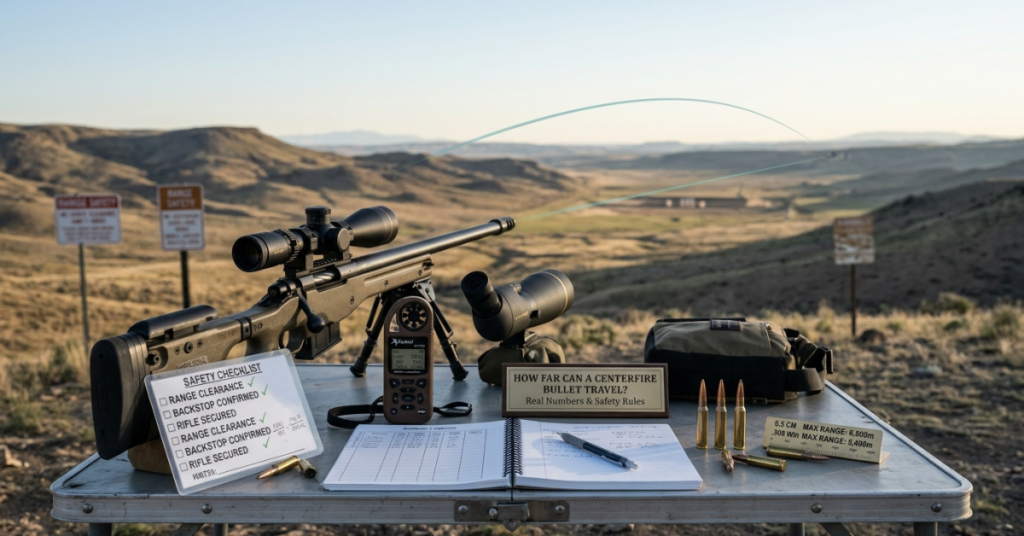
A centerfire How Far Can a Centerfire Bullet Travel, and a centerfire handgun bullet can travel more than a mile. One published table lists about 1.7 to 2 miles for a .223/5.56, 2.3 to 2.5 miles for a .308 Winchester and roughly 2.8 miles for a .30-06 at maximum range. Treat every shot as a potential miles-long hazard, even though your target sits a few hundred yards away.
This guide gives you the numbers, explains why sources disagree, and shows you how to shoot safely.
Quick Answer: Maximum Range by Caliber
Published figures vary by source, bullet design and test method. Use these as order-of-magnitude safety numbers, not precise predictions.
| Caliber | Approx. Maximum Flight Range | Typical Effective Range |
|---|---|---|
| 9mm (handgun) | About 2,000 yards (about 1.1 miles) | Tens of yards for most defensive and range use |
| .223 / 5.56 | About 2.2 miles | About 300 yards |
| .308 Winchester | About 2.6 miles | About 500 yards |
| .30-06 Springfield | About 3.0 miles | About 500 yards |
| .300 Win Mag | About 3.5 miles | About 800 yards |
| .50 BMG | About 5 miles | 1,500+ yards |
Maximum range assumes an optimal firing angle and no obstructions. Effective range depends on the shooter, the load and the purpose.
Why You’ll See Different Numbers Online
Search results disagree. One source puts a .308 at 3 to 5 miles, while another lists about 2.3 to 2.5 miles. Both can appear reasonable, because bullets, velocities and test conditions differ.
History proves the point. The U.S. Army’s .30-06 cartridge was originally claimed to reach 4,700 yards, but firing tests around 1918 showed an actual maximum of 3,300 to 3,400 yards. A later heavy boat-tail bullet reached approximately 5,500 yards.
The lesson: bullet shape and weight change the answer dramatically. Plan for miles, not for a single exact figure.
What Determines How Far a Bullet Flies
- Muzzle velocity: Faster bullets carry farther.
- Bullet weight and shape: Streamlined, heavy bullets keep their speed longer.
- Launch angle: Many guides say maximum range comes at around 30 to 35 degrees, not 45, because air resistance matters over long distances.
- Environment: Air density, altitude and wind change the flight path.
- Terrain: Hills, water and trees change where a bullet lands or ricochets.
Maximum Range vs. Effective Range vs. Danger Zone
Know the three ranges:
- Maximum range: The farthest distance a projectile travels before gravity and air resistance bring it to the ground.
- Effective range: The distance at which you can reliably hit your target ethically. For hunters, that depends on shooter ability and the bullet’s ability to expand and penetrate at impact speed.
- Danger zone: The area where a bullet could still cause harm. For centerfire rifles, treat it as miles.
Long-range labels shift too. One shooting guide defines mid range as 300 to 600 yards, long range as 600 to 1,200 yards, extreme long range as 1,200 yards to one mile, and extended extreme long range as beyond a mile.
Don’t Forget Rimfire
A .22 Long Rifle isn’t centerfire, but it still matters for safety. Published guides give it a maximum range of about 1.5 miles, so apply the same backstop discipline.
Do Falling Bullets Still Hurt?
Yes, you can’t assume a bullet fired upward is harmless. Julian Hatcher’s mid-century experiments found that a .30 caliber bullet fired straight up reached about 9,000 feet and returned at roughly 300 feet per second. A bullet at that speed can still break skin in practically all cases.
Two points matter most:
- Wind moves bullets. Even straight-up shots can land up to two miles away.
- Angled shots are worse. Bullets fired at 45 degrees or less can be far more lethal because they stay at much higher speeds.
Never fire into the air, for any reason.
7 Safety Rules for Every Shooter
- Know your target and what’s beyond it. A miss keeps flying.
- Use a proper backstop. Choose an earthen berm, a hillside or a purpose-built bullet trap. Designed ranges use backstops and bullet traps to stop missed shots.
- Shoot on a range designed for your firearm. Check its rated calibers before you load.
- Keep your muzzle in a safe direction. Control it at all times.
- Never shoot at the skyline or at water and hard surfaces. Bullets can ricochet or fly on.
- Check what’s behind your target at every distance. Roads, houses and trails count.
- Treat every round as your responsibility. You own where each bullet goes.
Safety Tips by Shooter Type
Range Shooters
- Confirm the range’s backstop height and berm layout.
- Aim only at your assigned target and stop if anything crosses the downrange area.
- Follow range officers’ commands without exception.
Hunters and Outdoor Sportsmen
- Identify your target and the ground behind it before you press the trigger.
- Prefer shots with a hillside or solid ground as a backstop. Avoid skyline shots.
- Know property lines, trails and nearby buildings. The danger zone for a rifle reaches miles.
- Choose a cartridge and load that suits your effective range, not your maximum range.
Concealed Carry and Defensive Trainees
- Understand that every handgun bullet can travel over a mile and can pass through walls and obstacles.
- Practice target identification and awareness of what’s behind your target.
- Train with an instructor who covers legal responsibility, since you answer for every round fired. This isn’t legal advice, so consult a qualified attorney and your state’s laws.
FAQ: How Far Can a Centerfire Bullet Travel?
How far can a 9mm bullet travel?
One published figure puts it at about 2,000 yards, or 1.1 miles. Other sources claim more, so assume it’s well over a mile.
How far can a .223 or 5.56 bullet travel?
Published ranges run from about 1.7 to 2.2 miles for typical loads, with some sources citing more.
How far can a .308 bullet travel?
Estimates range from about 2.3 to 2.6 miles in some sources to 3 miles or more in others. Plan for at least 2.5 to 3 miles.
What’s the difference between effective and maximum range?
Effective range is where you can hit reliably and ethically. Maximum range is where the bullet falls to the ground.
Can a bullet fired in the air kill someone?
Yes. Bullets fired at an angle stay fast, and even vertical shots can break skin and carry downwind.
Which angle gives the longest range?
Many guides cite roughly 30 to 35 degrees for typical rifle bullets, not 45 degrees. That’s a safety reminder: an upward muzzle angle sends bullets surprisingly far.
The Takeaway
A centerfire bullet can fly from about a mile for handguns to several miles for rifles. Published numbers vary, so plan for the high end.
Your responsibility doesn’t end at your target. Use a real backstop, know what lies beyond, never fire into the air, and shoot only where the danger zone is clear.
Ballistic figures vary by cartridge, bullet design, altitude and test method, so treat them as safety estimates, not predictions. I haven’t tested these distances myself, so this guide draws on published sources and historical military tests. Follow your range rules, local laws and hunter-education guidance. I can also turn this into a Word doc or an HTML page, or write a version for hunter-education courses or range safety signage.