
How to Time Travel: What Physics Really Says (and the One Method That Works Today)
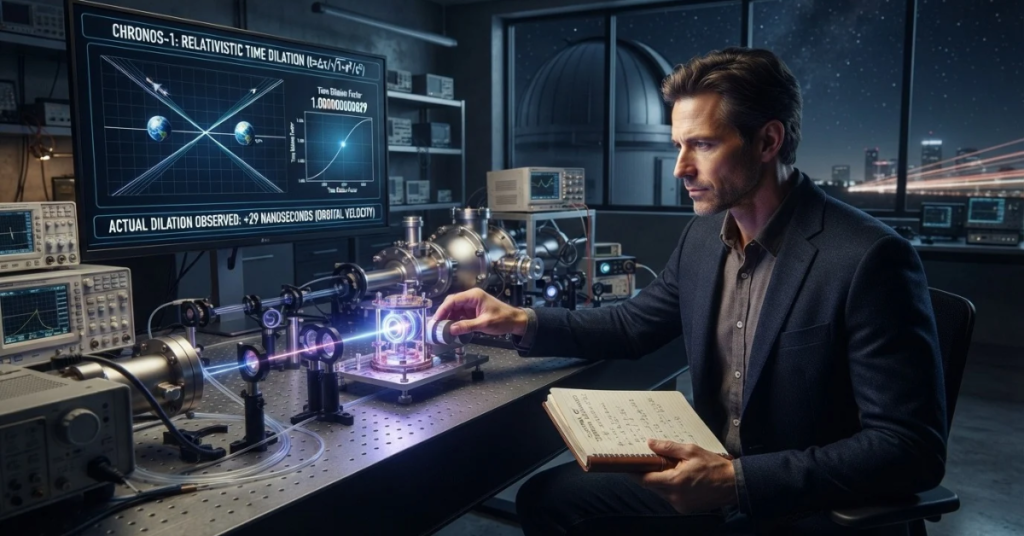
A science-backed guide for sci-fi fans, curious minds, gamers, and writers. Updated November 2026.
Here is how to time travel, in one sentence: move very fast or sit deep in a gravity well, and your clock slows down compared with everyone else’s, which sends you into their future. Physicists have measured this effect with atomic clocks, GPS satellites, and astronauts, so forward time travel is real, but only by tiny amounts.
Time travel to the past is a different story. General relativity allows some exotic solutions, but no one has found a practical way to build one.
This guide shows you exactly how forward time travel works, how to calculate your own jump into the future, and why traveling backward remains science fiction.
Key takeaways
- Future travel is proven. Time dilation slows your clock when you move fast or sit in strong gravity.
- The effect is tiny today. Cosmonaut Sergei Krikalev jumped about 0.02 seconds into the future after 803 days in orbit.
- Past travel is only theoretical. Wormholes and other closed timelike curves need exotic matter that no one has found.
- Paradoxes shape the rules. Writers and game designers pick one consistent model: fixed, branching, or changeable timelines.
- You can calculate it yourself. One short formula turns any speed into a time-travel jump.
Can You Really Time Travel? The Short Answer
Yes in one direction, and probably not in the other. This table summarizes where the science stands.
| Direction | Possible? | Evidence | Practical today? |
|---|---|---|---|
| Forward in time | Yes | Atomic clocks, GPS satellites, particle decay, astronauts | Only by tiny fractions of a second |
| Backward in time | Unknown | Mathematical solutions only, no experiments | No |
How to Time Travel to the Future
You already travel into the future at a rate of one second per second. Relativity gives you two ways to speed that up.
Method 1: Move Fast (Special Relativity)
Albert Einstein’s 1905 special theory of relativity says that moving clocks run slow when measured by a stationary observer. The faster you go, the bigger the effect.
The formula uses the Lorentz factor, written as gamma (γ):
γ = 1 / √(1 − v²/c²)
Here, v is your speed and c is the speed of light (299,792,458 meters per second). Multiply your ship time by γ to find how much time passes on Earth.
This table shows how one year on board converts to Earth years:
| Speed (fraction of light) | Gamma (γ) | 1 year on your ship equals |
|---|---|---|
| 0.5c | 1.15 | 1.15 Earth years |
| 0.9c | 2.29 | 2.29 Earth years |
| 0.99c | 7.09 | 7.09 Earth years |
| 0.999c | 22.4 | 22.4 Earth years |
| 0.9999c | 70.7 | 70.7 Earth years |
Method 2: Use Gravity (General Relativity)
Einstein’s 1915 general theory adds a second route. Clocks run slower the deeper they sit inside a gravitational field.
A traveler who orbits close to a massive object, such as a black hole, would age more slowly than distant observers. Experiments have even measured this effect across a height difference of only 33 centimeters.
Proof That Forward Time Travel Works
Three real-world tests show that time dilation is not just a theory.
- Hafele–Keating experiment (1971). Joseph Hafele and Richard Keating flew four cesium atomic clocks around the world on commercial airliners. The eastbound clocks lost 59 nanoseconds, and the westbound clocks gained 273 nanoseconds compared with clocks at the US Naval Observatory. The team published the results in Science in 1972.
- GPS satellites. Each satellite orbits about 20,200 kilometers up. Its clock runs about 45 microseconds per day fast because of weaker gravity, and about 7 microseconds per day slow because of its speed. The net gain is roughly 38 microseconds per day, and engineers correct for it constantly. Without that correction, position errors would grow by roughly 11 kilometers every day.
- Astronauts. Sergei Krikalev logged 803 days, 9 hours, and 39 minutes in orbit, which put him about 0.02 seconds into Earth’s future. An astronaut on a six-month International Space Station stay gains roughly 0.007 seconds.
Particle physics supplies a fourth example. Muons that cosmic rays create in the upper atmosphere survive long enough to reach the ground because their internal clocks run slow.
The Catch: Energy and One-Way Tickets
Two limits keep forward time travel from becoming a vacation option.
- Energy: Accelerating a one-ton spacecraft to 0.99c requires roughly 5.5 × 10²⁰ joules. That is on the same order as the energy all of humanity uses in a year.
- No return trip to your own past: You can leap ahead, but you cannot come back to the Earth you left. You arrive in the future, and you stay there.
How to Calculate Your Own Time Travel Jump
Follow these four steps to find out how far into the future a fast trip would send you.
- Choose your speed as a fraction of light speed. For example, pick 0.99.
- Calculate gamma with γ = 1 / √(1 − v²/c²). At 0.99c, γ is about 7.09.
- Multiply your ship time by gamma. If you travel for 10 years by your own clock, Earth ages about 70.9 years.
- Subtract your ship time to find the jump: 70.9 minus 10 equals about 60.9 years into the future.
This simple version ignores the acceleration and turnaround phases, so treat it as an estimate.
How to Time Travel to the Past
Backward travel sits in the gap between mathematics and experiment. General relativity allows spacetime paths called closed timelike curves (CTCs), which loop back on themselves and would return a traveler to an earlier moment.
Where Physicists Found Closed Timelike Curves
Several theoretical structures would create them:
- Gödel’s rotating universe (1949): Kurt Gödel showed that the equations of general relativity allow CTCs, even though our universe does not match his model.
- Wormholes (1983 onward): Kip Thorne and colleagues explored tunnels through spacetime that could link two different times.
- Cosmic strings (1991): J. Richard Gott showed that two infinitely long, ultra-thin strings passing each other could create CTCs.
- Tipler cylinder (1974): Frank Tipler proposed an extremely dense, rapidly spinning cylinder of enormous length.
The Wormhole Time Machine, Step by Step
The wormhole design is the most famous, and it contains a detail that surprises most readers.
- Open a stable wormhole. Physicists believe this would require exotic matter with negative energy density.
- Move one mouth. Send one end of the wormhole on a near-light-speed round trip, so its clock falls behind the other end.
- Compare the two mouths. The moving end now sits in an earlier time than the stationary end.
- Step through. You travel from the later mouth to the earlier one, and back in time.
The key limit: you can only travel back to the moment the time machine started running. You could never visit the dinosaurs.
Why Backward Time Travel Probably Fails
Four obstacles stand in the way.
- Exotic matter: No one has found negative-energy matter in the quantities a wormhole needs.
- Chronology protection: Stephen Hawking proposed in 1992 that quantum effects would destroy any time machine before it could work.
- Missing theory: Physicists lack a complete theory of quantum gravity to test these ideas.
- No visitors: In 2009, Hawking held a party for time travelers and announced it only after the event ended. No one showed up.
Researchers have simulated CTC behavior with photons in the lab. These experiments test the math, but they do not build a time machine.
Time Travel Methods Compared
| Method | Direction | Real or theoretical | Main requirement | Verdict |
|---|---|---|---|---|
| High-speed travel | Future | Proven | Near-light speed | Real, but tiny effect |
| Gravity well | Future | Proven | Strong gravity | Real, but tiny effect |
| Traversable wormhole | Past or future | Theoretical | Exotic matter | Speculative |
| Cosmic strings | Past | Theoretical | Infinite strings | Very speculative |
| Tipler cylinder | Past | Theoretical | Enormous spinning mass | Very speculative |
| Lab CTC simulation | None | Experimental | Quantum optics | Simulation only |
Time Travel Paradoxes Explained (For Writers and Gamers)
Paradoxes explain why fiction needs rules. Each model below gives you a consistent way to handle them.
| Paradox | The problem | Proposed fix | Where you see it |
|---|---|---|---|
| Grandfather paradox | You prevent your own birth | Self-consistency: events cannot contradict themselves | 12 Monkeys |
| Bootstrap paradox | Information has no origin | A closed causal loop with no starting point | Interstellar |
| Changeable past | The past changes the future | A mutable timeline that updates | Back to the Future |
| Branching timelines | Changes create a new reality | Many-worlds branches | Avengers: Endgame, Steins;Gate |
Rules Every Time Travel Story Needs
Follow these tips whether you design a game, write a novel, or plan a tabletop campaign.
- Pick one model. Choose fixed, branching, or mutable timelines, and stick with it.
- Set a cost. Limit travel with energy, range, or time spent, so tension survives.
- Define a destination rule. Decide whether travelers can reach any date or only dates after a machine existed.
- Show consequences early. Let players or readers see one small change ripple outward.
- Respect your own logic. Audiences forgive big ideas, but not broken rules.
Games show these models well. Outer Wilds and Deathloop use time loops, Life Is Strange and Braid use rewinding, and Chrono Trigger and The Legend of Zelda: Ocarina of Time use travel between eras.
Common Time Travel Myths
- “Someone already built a time machine.” No peer-reviewed evidence supports this claim.
- “Time travel apps exist.” No app can alter time. Any app that claims otherwise is entertainment.
- “Faster-than-light travel is easy.” Relativity treats the speed of light as a barrier for anything with mass.
- “Astronauts become much younger.” The difference amounts to fractions of a second.
Frequently Asked Questions
Is time travel possible?
Forward time travel is possible and measured, but only in tiny amounts today. Backward time travel remains theoretical.
How do you time travel to the future?
Move at a large fraction of light speed or spend time in a strong gravitational field. Both slow your clock compared with the rest of the universe.
How fast would you need to go?
Speeds above 0.9c produce noticeable effects. At 0.99c, one year on your ship equals about seven years on Earth.
Has anyone actually time traveled?
Yes, in a limited sense. Cosmonaut Sergei Krikalev gained about 0.02 seconds after 803 days in orbit, and GPS satellites gain about 38 microseconds per day relative to the ground.
Can you time travel to the past?
General relativity allows it in certain theoretical models, but no one has found a workable method. Hawking’s chronology protection conjecture suggests that nature may forbid it.
Could a wormhole let me visit the dinosaurs?
No. A wormhole time machine only lets you return to the moment its creator built it.
What did Einstein say about time travel?
Einstein’s relativity predicts forward time dilation. His equations also allow closed timelike curves, a point Kurt Gödel later developed.
Final Thoughts: The Only Time Machine You Can Use Today
The honest answer to how to time travel is this: you already do it, one second at a time, and you can nudge it by moving fast or sitting near a heavy mass. The effect is real, measurable, and tiny.
Use the formula in this guide to run your own numbers, then share it with a friend who loves sci-fi. For writers and gamers, pick a paradox model and build your story around it.