
Are North Koreans Allowed to Travel? What the Law Says and What Happens in Practice
The Quick Answer
No, not freely. North Korea’s constitution guarantees citizens “freedom of residence and travel,” but in practice the state tightly controls both movement inside the country and travel abroad.
Human Rights Watch reports that traveling between provinces or abroad without prior approval is illegal in North Korea. Amnesty International says travel permits are required for journeys between provinces, and checkpoints are heavily monitored.
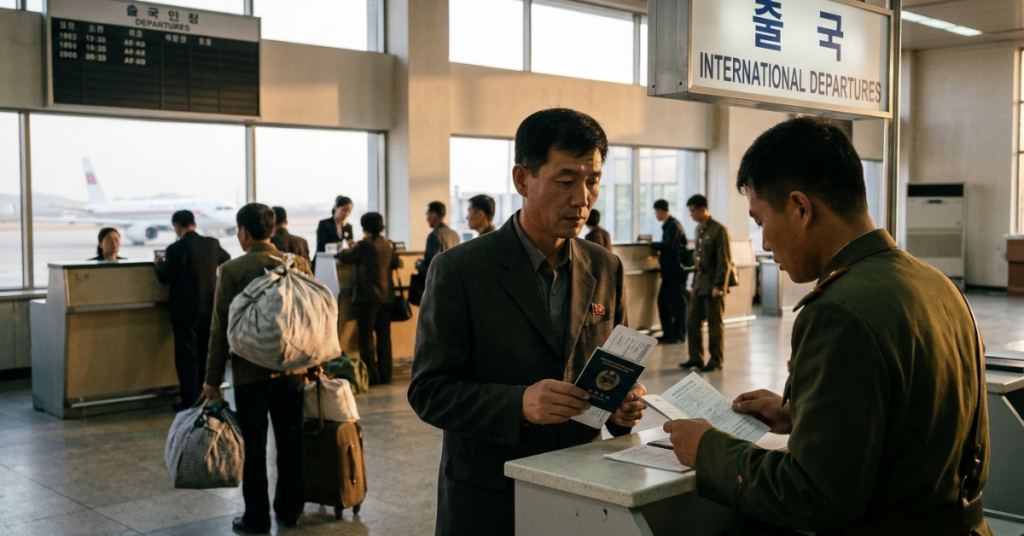
A small number of people travel abroad with state approval, mostly officials, diplomats, athletes, artists, students, and state-dispatched workers. Ordinary North Koreans cannot take a vacation abroad.
Quick Facts
- Constitution, Article 75: guarantees freedom of residence and travel (added in the 1998 revision, according to South Korea’s KINU).
- In practice: permits are required for provincial travel, and unauthorized travel abroad is a serious offense.
- Pyongyang: requires a residence permit to enter, according to an Oxford Refugee Studies Centre paper.
- Defectors in 2025: 224 reached South Korea, against more than 1,000 in a typical pre-pandemic year.
- First half of 2026: 63 defectors arrived, down 34.4% from the same period in 2025.
Law vs. Reality
| Topic | On paper | In practice |
|---|---|---|
| Freedom of travel | Article 75 guarantees it | Permits, checkpoints, and approvals control movement |
| Travel between provinces | Not formally banned | Requires an official permit, which rights groups say is difficult to obtain |
| Travel abroad | No stated blanket ban | Illegal without prior approval; allowed only for state-approved purposes |
| Pyongyang and border areas | Open to citizens in theory | Special permits needed |
| Leaving illegally | Criminal offense | Human Rights Watch says those caught or forcibly returned face severe punishment |
How Domestic Travel Works
Travel inside North Korea runs on permits. Citizens must apply, give a reason, and receive approval before they move between provinces or enter special zones such as Pyongyang and border areas.
Human Rights Watch says before 2020 some enforcement loosened through bribes. It reports that this flexibility has since reversed.
Recent reporting points to tighter control:
- Railway checks: A July 2025 report from Korean outlet Asia Economy described new identity checks, including a temporary entry permit called a “Nadeulpyo” for anyone entering station premises.
- Disrupted plans: Daily NK, citing sources inside the country, reports that tighter restrictions have forced people to cancel or delay trips such as weddings and business visits.
Keep in mind that North Korea restricts independent reporting. Daily NK relies on sources inside the country, which outside observers cannot always verify.
Who Can Travel Abroad?
A small, state-selected group travels abroad.
| Group | Typical purpose | Conditions |
|---|---|---|
| Officials and diplomats | Government business | State assignment |
| Athletes and artists | Competitions and performances | State approval |
| Students | Study abroad | State approval |
| Overseas workers | Labor in countries such as Russia and China | Dispatched by the state |
Overseas workers face heavy control. Human Rights Watch reports that workers described confiscated passports, restricted movement, harsh surveillance, and 12- to 14-hour workdays. Global Rights Compliance also documents passport confiscation in its worker interviews.
Researchers at Oxford’s Refugee Studies Centre describe the labor program as part of Pyongyang’s strategy to export labor and control workers abroad.
Can Ordinary North Koreans Take Vacations?
Abroad, no. Ordinary citizens do not travel overseas for leisure.
At home, North Korea has built resorts for domestic and international tourism. Researchers at Yonsei University’s PSCORE argue that most citizens still face the internal permit system, so access remains uncertain.
What About Escaping?
People who leave without permission risk serious punishment, and the numbers show how hard escape has become.
| Year | Defectors reaching South Korea |
|---|---|
| 2019 | 1,047 (before COVID border closures) |
| 2023 | 196 |
| 2024 | 236 |
| 2025 | 224 |
| First half of 2026 | 63 (down 34.4% year on year) |
South Korea’s Unification Ministry says the cumulative total stands near 34,600. The ministry attributes the 2026 drop to tighter border controls and restricted movement through third countries.
China maintains a policy of forced repatriation, according to Kyunghyang Shinmun. South Korean officials and rights groups warn that people returned to North Korea face harsh treatment.
Many recent arrivals left North Korea years earlier. The ministry says they spent time in China or other countries before reaching the South.
Why Does North Korea Restrict Movement?
North Korea does not publish its reasons in a form outsiders can verify. Rights groups and researchers offer these explanations:
- Political control. Restricting movement limits contact with outside information.
- Population management. Permits help the state control who lives and works where, including in Pyongyang.
- Preventing escape. Border controls and passport rules reduce defection.
Treat these as analysts’ interpretations, not official statements.
Can Foreigners Visit North Korea?
Foreign tourism exists but stays tightly controlled. Visitors travel with approved guides, and independent travel is banned.
U.S. citizens face an additional barrier: Washington has renewed a ban on using U.S. passports for travel to North Korea since 2017. In June 2026, the Korea Times, citing NK News, reported that a travel firm said Pyongyang had begun barring U.S. dual nationals from entering.
Check your government’s current travel advice before considering any trip.
Common Questions
Do North Koreans need permission to travel inside their own country? Yes. Provincial travel and entry to Pyongyang or border zones require permits.
Is it legal for a North Korean to leave the country on their own? No. Human Rights Watch says traveling abroad without prior approval is illegal.
Can North Koreans visit South Korea? Not as ordinary travelers. Official delegations have visited for events, and defectors arrive through third countries.
Has the border with China reopened? North Korea lifted its COVID-era border closure in late August 2023, according to Kyunghyang Shinmun. Movement across the border remains tightly controlled.
Why do so few North Koreans defect now? The Unification Ministry cites tighter border controls and restricted movement through third countries. Analysts also point to China’s repatriation policy.
How I Researched This
This guide draws on Human Rights Watch, Amnesty International, South Korea’s Korea Institute for National Unification, the Oxford Refugee Studies Centre, South Korea’s Unification Ministry data reported by the Korea Herald and Korea Times, and news reports from Daily NK and Asia Economy.
Information from inside North Korea is hard to verify. Rules and enforcement can change without public notice, so check recent reporting before you rely on any single detail.