
How Fast Does a 9mm Bullet Travel? Real Chronograph Numbers in FPS, MPH, and m/s
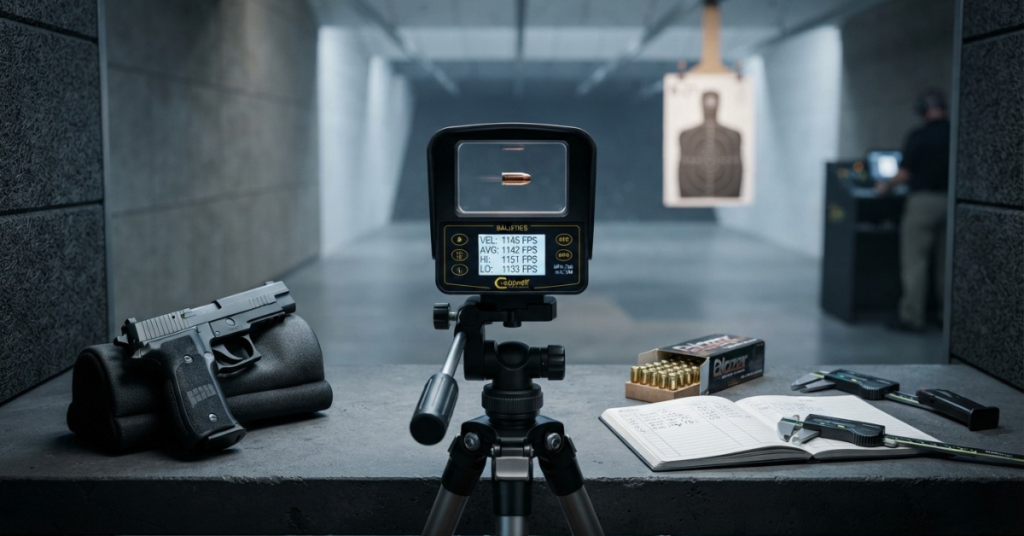
How Fast Does a 9mm bullets Travel leave a typical handgun at about 1,000 to 1,250 feet per second (fps). That equals roughly 680 to 850 miles per hour, or 305 to 380 meters per second.
Standard 115- to 124-grain loads fired from 3.5- to 4.6-inch barrels measure about 1,130 to 1,260 fps in chronograph tests. That puts them right around the speed of sound, which is about 1,125 fps at room temperature. Heavier 147- and 158-grain loads run slower, often around 950 to 1,050 fps, and stay below the speed of sound.
Key Takeaways
- Typical speed: About 1,000 to 1,250 fps from common handgun barrels.
- Supersonic or subsonic? Light and standard-weight 9mm loads hover near or above the speed of sound, while heavy bullets stay subsonic.
- Barrel length matters. A common rule of thumb is about 50 fps per inch, though real results vary by gun and load.
- Box numbers run high. Manufacturers often test in special barrels, so your gun may measure lower.
- Speed is only part of the story. Bullet design, shot placement, and safe handling matter more than a few extra fps.
How Fast Does a 9mm Bullet Travel? Quick Answer by Load
The table below shows measured velocities from one chronograph test comparing a Walther PDP with a 3.5-inch barrel and a CZ-75 with a 4.6-inch barrel.
| Load | 3.5-inch barrel (fps) | 4.6-inch barrel (fps) | Gain (fps) |
|---|---|---|---|
| Winchester 115-grain FMJ | 1,202 | 1,235 | +33 |
| Winchester 115-grain JHP | 1,127 | 1,183 | +56 |
| Federal Punch 124-grain JHP | 1,145 | 1,194 | +49 |
| Hornady Critical Duty 124-grain +P | 1,149 | 1,202 | +53 |
| Hornady Critical Duty 135-grain +P | 1,090 | 1,114 | +24 |
| Winchester 124-grain NATO FMJ | 1,164 | 1,256 | +92 |
| Buffalo Bore 124-grain +P+ | 1,239 | 1,324 | +85 |
Data: Gun Mag Warehouse barrel-length test. Results vary by pistol, ammunition lot, and temperature.
9mm Bullet Speed in FPS, MPH, m/s, and Mach
Use this conversion table to translate common velocities. The Mach column compares each speed with the speed of sound at about 1,125 fps.
| Velocity (fps) | Meters per second | Miles per hour | Mach number |
|---|---|---|---|
| 950 | 289.6 | 647.7 | 0.84 |
| 1,000 | 304.8 | 681.8 | 0.89 |
| 1,050 | 320.0 | 715.9 | 0.93 |
| 1,100 | 335.3 | 750.0 | 0.98 |
| 1,150 | 350.5 | 784.1 | 1.02 |
| 1,200 | 365.8 | 818.2 | 1.07 |
| 1,250 | 381.0 | 852.3 | 1.11 |
| 1,300 | 396.2 | 886.4 | 1.16 |
Is a 9mm Bullet Supersonic?
It depends on the load. The speed of sound is about 1,125 fps at 68°F (343 m/s) and about 1,087 fps near freezing, so colder air lowers the threshold slightly.
- 115- and 124-grain loads often measure near or above that line, so many are supersonic.
- 147-grain loads typically travel around 1,000 to 1,050 fps from standard pistol barrels, which is subsonic.
- 158-grain loads advertise about 950 fps or less from pistols, and stay subsonic even from longer barrels.
Subsonic ammunition does not produce the sharp sonic crack that supersonic bullets create.
What Affects 9mm Bullet Velocity?
| Factor | Effect on speed | Notes |
|---|---|---|
| Barrel length | Longer barrels usually add speed | Tests show roughly 24 to 92 fps from 3.5 to 4.6 inches, depending on the load |
| Bullet weight | Heavier bullets usually travel slower | A 124-grain bullet generally beats a 147-grain bullet |
| Pressure level | Higher pressure loads run faster | SAAMI sets maximum average pressure at 35,000 psi for standard loads and 38,500 psi for +P |
| Gun-to-gun variation | Same-length barrels can differ | One NRA test found 57 to 71 fps differences between 5-inch barrels |
| Temperature | Can shift results | Test conditions often include cold or warm days |
| Manufacturer testing | Box numbers often run high | Companies often use test barrels, not real pistols |
Rule of thumb: The NRA’s Shooting Sports USA tests describe a general guide of about 50 fps per inch of barrel length. They also stress that it is not a fixed rule. In one test, a 5-inch barrel produced almost no gain over a 4.25-inch barrel.
Barrel Length: How Much Does It Matter?
Josh Wayner of Ammoland tested a Glock 43 (3.39 inches), a Glock 19 (4 inches), and a Glock 34 (5.3 inches). He found that 9mm velocity rises in a clear, predictable step as barrel length grows, unlike the .45 ACP in his companion test.
Heavier bullets show smaller gains in some cases. One Federal 147-grain load varied by only 54 fps across barrel lengths, a loss of 5.5% from the longest barrel to the shortest.
Speed vs. Energy: Why Faster Is Not Always Better
Bullet energy depends on both weight and speed. You can estimate it with this formula:
Energy (ft-lbf) = (bullet weight in grains × velocity²) ÷ 450,240
| Example | Weight | Velocity | Energy (approx.) |
|---|---|---|---|
| Standard 115-grain | 115 grains | 1,200 fps | 368 ft-lbf |
| Standard 124-grain | 124 grains | 1,150 fps | 364 ft-lbf |
| +P 124-grain | 124 grains | 1,200 fps | 397 ft-lbf |
| Heavy 147-grain | 147 grains | 1,000 fps | 327 ft-lbf |
A 50 fps gain from 1,150 to 1,200 fps adds about 9% to the energy. Shot placement, reliable feeding, and bullet design usually matter far more than that difference.
How Does a 9mm Bullet’s Speed Change Downrange?
Air drag slows every bullet. Pistol bullets are short and blunt, so they lose speed faster than long rifle bullets do.
A bullet traveling about 1,100 fps covers 25 yards in roughly 0.07 seconds, ignoring drag. That is too fast for a person to see or react to.
9mm vs. Other Common Cartridges
These figures are typical factory ranges, so exact numbers vary by load and barrel.
| Cartridge | Typical muzzle velocity | Notes |
|---|---|---|
| .22 LR | About 1,000 to 1,300 fps | Small, light bullet |
| 9mm Luger | About 1,000 to 1,250 fps | Subject of this guide |
| .40 S&W | About 1,000 to 1,150 fps | Heavier bullet, similar speed range |
| .45 ACP | About 830 to 900 fps | Heavy, slower bullet |
| 5.56 NATO (rifle) | About 2,900 to 3,100 fps | Rifle cartridge fired from long barrels |
Notes for First-Time Gun Owners
Knowing a bullet’s speed does not make a firearm safe. These habits do.
- Treat every gun as loaded.
- Keep the muzzle pointed in a safe direction.
- Keep your finger off the trigger until your sights are on the target and you are ready to fire.
- Know your target and what is beyond it. Bullets can travel far past what you can see.
- Never fire into the air. A bullet falling back to earth travels much slower than at the muzzle, but it can still injure or kill.
- Wear hearing and eye protection every time you shoot.
- Store firearms securely, especially around children.
- Take a safety course from a qualified instructor.
Notes for CCW Holders and Range Shooters
Muzzle velocity matters most as a way to compare loads and check consistency. Use these tips.
- Expect lower numbers than the box. Manufacturers often test with special barrels, so real guns usually measure lower.
- Chronograph your own ammo. Fire a 10-shot string, and record the average and the spread.
- Follow your chronograph’s distance instructions. Many testers measure around 5 to 10 feet from the muzzle.
- Record the temperature and your barrel length.
- Prioritize reliability. Choose ammunition that feeds, fires, and ejects without problems in your gun.
- Do not chase fps. A 50 fps difference matters less than dependable function and accuracy.
Notes for Physics Students
You can use a 9mm bullet to practice kinetic energy and momentum. One grain equals about 0.0648 grams, so a 124-grain bullet weighs about 8.0 grams.
Worked example (124-grain bullet at about 350 m/s, or 1,150 fps):
- Mass: 124 × 0.0648 g ≈ 8.04 g, or 0.00804 kg
- Kinetic energy: ½ × 0.00804 × 350² ≈ 492 joules
- Momentum: 0.00804 × 350 ≈ 2.8 kg·m/s
The 492 joules equals about 363 foot-pounds, which matches the table above.
Extension question: Why does a bullet that travels at roughly Mach 1 produce a sharp crack, while a subsonic bullet does not? Think about shock waves and the speed of sound.
Notes for Fiction Writers, Gamers, and Tactical Media Creators
Realistic details make scenes more believable.
- Nobody sees or dodges a bullet. A 9mm bullet covers a room’s length in a few hundredths of a second.
- Supersonic bullets make a crack. Subsonic loads do not.
- Speed varies by load. Do not give every 9mm the same velocity.
- Ammunition and barrels differ. Short pistols slow bullets down, while carbines add speed.
- Keep safety in mind. Realistic depictions can include proper handling, such as muzzle discipline and hearing protection.
Common Myths About 9mm Speed
| Myth | Fact |
|---|---|
| All 9mm rounds are supersonic | Light and standard loads hover near the speed of sound, and heavy loads stay subsonic |
| Longer barrels always add speed | Gains usually appear, but they vary, and some barrels show little or no increase |
| Box velocity equals real-world velocity | Real guns often measure lower than test-barrel numbers |
| A bullet fired into the air returns at full speed | It falls at a much lower terminal velocity, but it can still be deadly |
| More fps always means a better load | Reliability, accuracy, and shot placement matter more than small speed gains |
Frequently Asked Questions
How fast does a 9mm bullet travel?
Most 9mm bullets travel about 1,000 to 1,250 feet per second at the muzzle. That equals roughly 680 to 850 mph.
How fast does a 9mm bullet travel in mph?
A 1,150 fps load travels about 784 mph, and a 1,000 fps load travels about 682 mph.
How fast does a 9mm bullet travel in meters per second?
Typical 9mm loads travel roughly 305 to 380 meters per second.
Is a 9mm bullet faster than the speed of sound?
Many 115- and 124-grain loads are near or above the speed of sound, which is about 1,125 fps at 68°F. Heavier 147-grain and 158-grain loads are usually subsonic.
Does barrel length change 9mm velocity?
Yes. A rough guide is about 50 fps per inch, but the actual change varies by gun and ammunition.
How fast is +P 9mm ammunition?
+P loads run at higher pressure, up to 38,500 psi under SAAMI specifications. In one test, a 124-grain +P load measured 1,149 fps from a 3.5-inch barrel and 1,202 fps from a 4.6-inch barrel.
Does a 9mm bullet slow down in flight?
Yes. Air drag steadily reduces its speed, and pistol bullets lose speed faster than long rifle bullets.
Why do box velocities differ from my chronograph?
Manufacturers often use test barrels, and individual guns vary. Temperature and measurement distance also affect results.
Final Thoughts
A 9mm bullet travels fast, typically around 1,000 to 1,250 fps, which equals roughly 680 to 850 mph. Barrel length, bullet weight, and pressure level all shift the exact number.
For most readers, the useful lesson is simple: treat published velocities as a guide, measure your own loads if you care, and put safe handling ahead of speed.
This article offers general information for education and does not provide reloading or firearm modification advice. Always follow your local laws and the instructions in your firearm’s manual.