
Where Did Marco Polo Travel? His Complete Route From Venice to China and Back
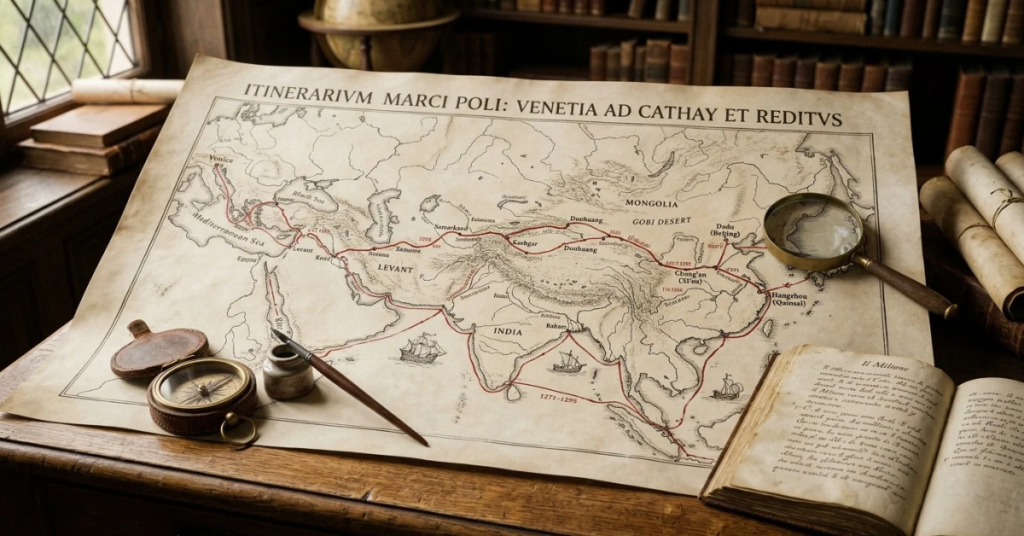
Quick answer: Marco Polo traveled from Venice across the Mediterranean to the Holy Land, then overland through Anatolia, Persia, and Central Asia to Kublai Khan’s court in China (c. 1271 to 1275). He served the Mongol Empire for about 17 years and crossed China’s interior and coast. He returned by sea through Southeast Asia, India, and Persia, and he reached Venice in 1295.
Key Takeaways
- Marco Polo spent roughly 24 years abroad (1271 to 1295).
- He left Venice at about age 17 with his father Niccolò and uncle Maffeo.
- He took the overland Silk Road to China and the maritime route home.
- He visited or described regions in modern Turkey, Iran, Afghanistan, Tajikistan, China, Vietnam, Indonesia, Sri Lanka, and India.
- Historians still debate how much of the route he traveled personally and how much he learned secondhand.
Marco Polo’s Journey at a Glance
| Stage | Approx. Dates | Key Stops | Modern Countries |
|---|---|---|---|
| Outbound (Mediterranean) | 1271 | Venice, Acre, Jerusalem, Ayas | Italy, Israel, Türkiye |
| Outbound (Middle East) | 1271–1272 | Sivas, Erzurum, Tabriz, Kerman, Hormuz | Türkiye, Iran |
| Outbound (Central Asia) | 1272–1274 | Balkh, Badakhshan, Pamirs, Kashgar, Khotan | Afghanistan, Tajikistan, China |
| Outbound (China) | 1274–1275 | Dunhuang, Ganzhou, Shangdu, Khanbaliq | China |
| Service to the Khan | 1275–1291 | Yangzhou, Hangzhou, Fujian, Yunnan | China, possibly Myanmar |
| Return (sea) | 1291–1293 | Champa, Sumatra, Sri Lanka, Malabar Coast | Vietnam, Indonesia, Sri Lanka, India |
| Return (overland) | 1293–1295 | Hormuz, Tabriz, Trebizond, Constantinople, Venice | Iran, Türkiye, Italy |
Dates are approximate because Polo’s own account is imprecise and few independent records confirm his movements.
Why Marco Polo Traveled East
Marco came from a Venetian merchant family. His father and uncle had already visited the Mongol Empire in the 1260s and met Kublai Khan, who asked them to bring back Christian missionaries and oil from the lamp at the Holy Sepulchre in Jerusalem.
The brothers set out again in 1271 and brought young Marco along. Trade, diplomacy, and the Mongol Empire’s relative security on its roads (often called the Pax Mongolica) made the trip possible.
Stage 1: Venice to the Middle East (1271–1272)
The Polos sailed from Venice to Acre, a Crusader port in the Holy Land. They continued to Jerusalem to collect the holy oil, then returned to Acre. There they met Tedaldo Visconti, who became Pope Gregory X and sent two friars with them. The friars turned back early because of the danger.
The party then crossed the Mediterranean coast to Ayas (Lesser Armenia) and traveled inland through Anatolia, passing places such as Sivas and Erzurum. They reached Tabriz in northwestern Persia, a major trading hub.
Stage 2: Persia and the Road to Hormuz
From Tabriz, the Polos moved south through Persia, visiting towns such as Saveh and Kerman. They then reached Hormuz, a busy Persian Gulf port.
They planned to sail onward, but Marco judged the ships unsafe. The group turned north and resumed the overland route.
Stage 3: Across Central Asia (1272–1274)
This stretch tested the travelers most. They crossed the deserts and mountains of the Silk Road, including:
- Balkh in present-day Afghanistan
- Badakhshan, where Marco reportedly recovered from an illness in the mountain air
- The Pamir Mountains, which Marco described as one of the highest places in the world
- Kashgar, Yarkand, and Khotan along the southern and western edges of the Taklamakan Desert
- Lop and the Gobi region, where Marco recorded local legends about desert spirits
Stage 4: Arrival in China and the Court of Kublai Khan (1275)
The Polos entered China through Dunhuang and passed through Ganzhou in Gansu. They then reached Shangdu, Kublai Khan’s summer capital. English-speaking readers know it as Xanadu thanks to Samuel Taylor Coleridge’s poem.
They finally arrived at Khanbaliq, the Mongol winter capital on the site of modern Beijing. Marco’s journey from Venice had taken about three and a half years.
Stage 5: Marco Polo in China (1275–1291)
Marco says he served Kublai Khan as an envoy and observer. His account places him in many parts of the empire:
- Yangzhou, where he claims to have held an official post (historians doubt this)
- Hangzhou, which he called Quinsai and praised as the finest city in the world
- Fujian, including the port of Quanzhou (which he called Zaiton), then one of the world’s largest harbors
- Yunnan in the southwest, and regions bordering modern Myanmar
He described paper money, coal fuel, the imperial postal relay system, and the scale of Chinese cities. European readers found these details startling.
Stage 6: The Sea Route Home (1291–1295)
The Polos asked to go home, and Kublai Khan agreed on one condition. They had to escort the Mongol princess Kököchin to Persia, where she would marry the Ilkhan ruler Arghun.
The fleet left Quanzhou around 1291 and sailed through the South China Sea. Polo’s account covers these stops:
- Champa (southern Vietnam)
- Java and Sumatra, where storms and monsoon winds held the fleet for about five months
- The Strait of Malacca region
- Sri Lanka, which he praised for its gems
- The Malabar and Coromandel coasts of India
- Hormuz, then onward to Persia
Arghun had died by the time the party arrived, so the princess married his son Ghazan. The Polos then traveled through Tabriz, Trebizond, and Constantinople, and returned to Venice in 1295.
What Marco Polo Described but May Not Have Visited
Polo’s book also covers lands he likely knew only from other travelers’ reports. These include Japan (which he called Cipangu), Madagascar, Zanzibar, Ethiopia, and parts of Siberia. Scholars treat these sections as hearsay unless other evidence supports them.
How Do We Know Where He Traveled?
Marco was captured in a Venice–Genoa naval conflict and jailed in Genoa around 1298. There he dictated his memories to the romance writer Rustichello da Pisa. The result was Il Milione, also known as The Travels of Marco Polo or Description of the World.
The book survives in roughly 150 manuscript versions, and they differ from one another. That variation makes exact reconstruction of his route difficult.
Did Marco Polo Really Go to China?
Historians disagree. Skeptics, notably Frances Wood in her 1995 book Did Marco Polo Go to China?, point to several gaps:
- He never mentions the Great Wall, tea, or Chinese characters.
- Chinese records do not name him.
- Some place names appear in Persian rather than Chinese forms.
Defenders, including Hans Ulrich Vogel, argue that his detailed descriptions of salt production, paper currency, and local taxes match Chinese sources. Most mainstream scholars accept that he did travel to China, while treating specific claims, such as his governorship, with caution.
Tips for Students, Teachers, and Researchers
- Cite carefully. Name the translation and edition, since manuscript versions vary.
- Separate eyewitness from hearsay. Mark which regions Polo claims to have visited.
- Cross-check with other sources. Compare Polo with Ibn Battuta, William of Rubruck, and Chinese and Persian records.
- Use a map activity. Have students plot the outbound and return routes in two colors.
Frequently Asked Questions
How long was Marco Polo’s journey?
He spent about 24 years away from Venice (1271 to 1295), including roughly 17 years in the Mongol Empire.
What countries did Marco Polo visit?
In modern terms, he likely passed through Italy, Israel, Türkiye, Iran, Afghanistan, Tajikistan, China, Vietnam, Indonesia, Sri Lanka, and India.
Did Marco Polo travel the Silk Road?
Yes. He used overland Silk Road routes to reach China and returned mainly by sea.
Did Marco Polo reach Japan?
No. He described Japan from secondhand accounts and never visited.
When did Marco Polo die?
He died in Venice in January 1324 at about age 69.
Conclusion
So, where did Marco Polo travel? He crossed the Middle East, Central Asia, China, Southeast Asia, and India during one of history’s most remarkable journeys. His book gave medieval Europeans their first detailed picture of Asia, and scholars still debate its accuracy today.
I can also put this in a Word doc or a downloadable file if you’d like, or adapt it for a classroom handout.